

Dream About Police: Help, Rules, and Being Heard
Explore eight police dream scenes through help, authority, questioning, and responsibility, while keeping personal experience ahead of a fixed meaning.
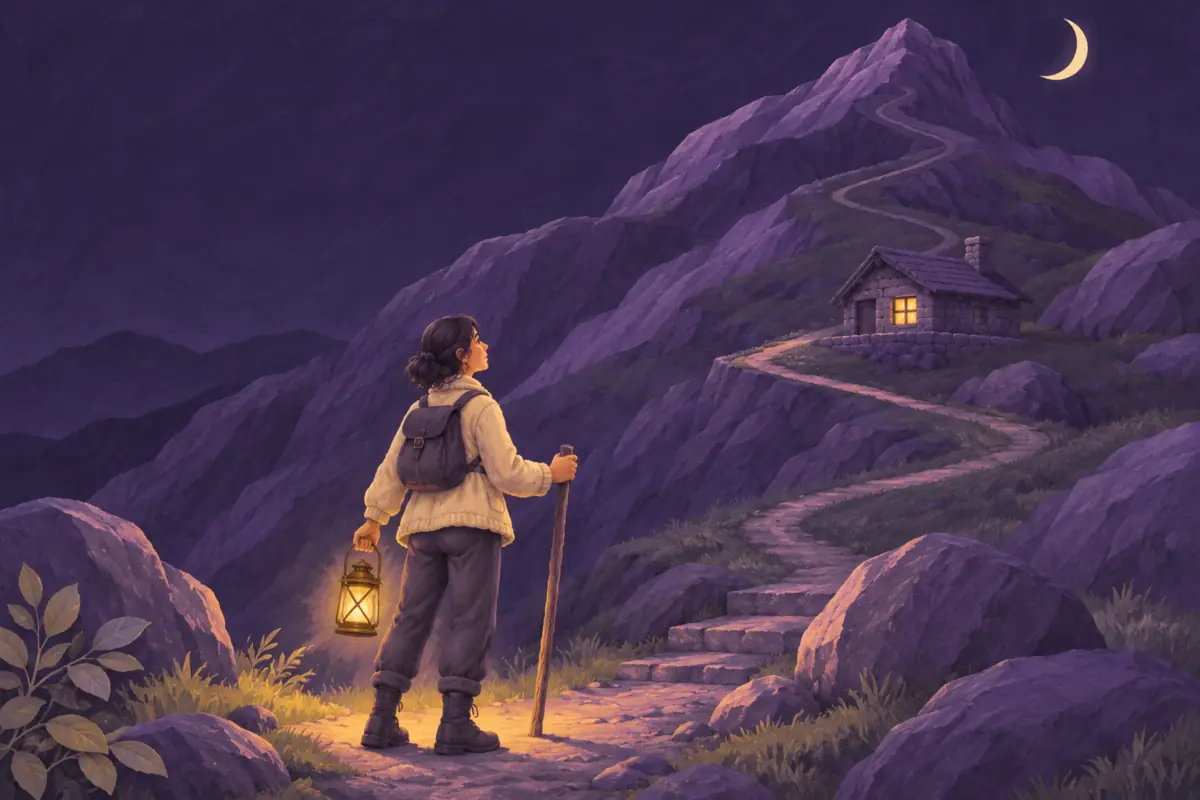
Explore mountain dreams through climbing, descending, distant summits, shelter, and familiar landscapes, with questions about the goal you actually wanted.
A dream about a mountain may involve the scale of a goal, effort, a wider view, protection, or attachment to a particular place. Climbing is only one possibility. Living beside a mountain or choosing to descend can be equally important. The landscape does not automatically represent ambition or a spiritual test you must complete.
| Scene | Detail to notice | Reflection question |
|---|---|---|
| Climbing a slope | Chosen goal or assigned task | Why was I going up? |
| Descending | Return, retreat, or another destination | What waited below? |
| An unreachable summit | A real barrier or an assumed requirement | Did I need to reach it? |
| A mountain provides shelter | Protection or enclosure | What did its presence make possible? |
| Living beside a mountain | Familiar background or valued landmark | What made this place home? |
| Reaching a viewpoint | Satisfaction, exposure, or changed scale | What could I see differently? |
| Traveling with others | Shared pace or competing needs | Whose goal shaped the route? |
| A mountain blocks your way | Going around or going over | Was the direct route necessary? |
Start with the reason for climbing. Were you curious about the view, following someone, completing a task, or trying to reach a particular person? An ascent chosen for pleasure differs from one that feels compulsory. The height alone cannot explain your motivation.
Notice the pace and terrain. A clear trail may make the effort steady, while shifting rocks or an absent path may make each step a decision. You might enjoy the work despite its difficulty, or feel frustrated even on an easy route because the destination holds little interest.
For reflection, ask what made continuing worthwhile. That question is more precise than assuming the mountain represents career success. A real goal may provide a comparison, but the dream cannot decide whether pursuing it is wise. Preserve your reason for climbing alongside the amount of effort required.
Downward movement is not necessarily defeat. You may have completed a visit, wanted to return to someone, or found that the next destination lay below. Describe what you were leaving and what you expected to find when you arrived.
The descent may feel easier than climbing, unexpectedly demanding, or unfamiliar even along the same route. Did you want to hurry, pause, or enjoy the view? A journey back can contain its own goals rather than simply undoing the ascent.
A personal comparison could concern returning from an intense period to ordinary responsibilities. It could also involve choosing a scale of activity that suits you better. Neither interpretation follows automatically from direction. The dream does not say you are lowering your ambitions. Ask what the movement served and whether it felt chosen before assigning it a positive or negative meaning.
An inaccessible peak may be visible beyond a gap, hidden by weather, or always farther away than expected. Record the actual obstacle. A route ending at a cliff differs from the dream's unexplained certainty that no one can go farther.
How did you respond? You might search for another path, wait, turn back, or discover that the place where you stopped already offered what you wanted. Frustration may concern the blocked route, an expectation you had promised to meet, or the presence of an audience.
For reflection, separate a desired outcome from a requirement you have accepted without examining it. Was reaching the top your goal or someone else's definition of completion? The dream cannot tell you to abandon a real aim. It can help you ask what counts as enough and what evidence would justify another attempt.
A mountain can function as a boundary that makes a valley, village, or resting place feel sheltered. Describe what it seemed to keep out: wind, an approaching event, unwanted visitors, or simply the vastness beyond. The protection may be practical within the story or an unexplained feeling.
Did the sheltered place feel comfortable, or did the same boundary make departure difficult? Security and restricted access can coexist. You may have welcomed the mountain while still wanting a route through it.
An editorial comparison could concern a structure or relationship that supports you but also shapes your choices. Keep both sides specific. The landscape does not prove that someone is protective or controlling in waking life. It may instead help you describe what kind of boundary feels useful and when you want more access to what lies beyond it.
Sometimes a mountain is part of daily life in the dream, not a challenge at all. You might see it from a window, use it to recognize home, or mention it casually to another person. The absence of a climb can be the central fact.
What made the place familiar: its shape, a road, the angle of light, or the people nearby? Even an invented landscape can feel known within the scene. Record that sense of belonging without claiming you have recovered a forgotten real location.
For reflection, consider landmarks that orient you without requiring achievement. A place can matter because it accompanies ordinary routines. The dream may invite attention to continuity, home, or a remembered view rather than ambition. If a specific mountain is part of your personal history, that relationship deserves priority over a generic interpretation about obstacles.
A viewpoint may change how the landscape appears rather than simply provide a reward. What could you see from there: a route you had taken, a settlement, another mountain, or an unexpectedly large distance? The new perspective can be satisfying, lonely, or disorienting.
Notice whether you wanted to share the view. You might look for a companion, take a picture, or realize that someone below could not see what you saw. That social detail can make communication more important than achievement.
A personal question concerns what distance clarifies and what it obscures. From far above, a route may look simple while individual obstacles disappear. The dream does not certify that you now understand a waking problem completely. It may help you recognize the value and limits of stepping back, provided you keep the actual circumstances in view.
Companions can make a mountain scene about pace and coordination. Were you leading, following, waiting, or struggling to keep everyone together? Shared travel does not necessarily mean everyone wanted the same destination or had the same reason for going.
Describe a moment when the group adjusted. Someone may have slowed down, offered a hand, chosen a different route, or insisted on continuing. Your response can reveal what felt fair or uncomfortable within the scene without establishing anyone's real character.
For reflection, ask how a shared goal accommodates different needs. This is more specific than treating the group as a symbol of family or colleagues. A waking comparison may fit, but it should preserve differences rather than turn every companion into a coded person. The dream's route can raise a question about cooperation without deciding who is right.
A mountain may be an obstacle because of where you want to go, even if you have no interest in climbing it. Was there a pass, tunnel, road around it, or another route you had not yet explored? The scene's geography determines the practical problem.
Notice whether you assumed that going over the top was the only legitimate solution. Someone else might offer a simpler path, or you might feel relief when the destination changes. A difficult direct route is not automatically more meaningful than an indirect one.
A personal comparison could concern the difference between solving a problem and proving you can withstand it. Keep the comparison tentative; the dream cannot assess your persistence or pride. It may simply help you identify what you wanted to reach and whether the method had become more important than the destination itself.
A mountain makes a persuasive metaphor for achievement, but that metaphor can crowd out other aspects of the scene. Before adopting it, write down your goal in ordinary language. “I wanted to see my friend on the other side” is more informative than “I was pursuing success.”
Then describe what changed the effort: terrain, time, company, information, or your own decision. You may have had little control over the mountain but several choices about the journey. Choosing to stop can represent satisfaction, caution, frustration, or a new priority. Movement alone does not decide which.
Your feeling about height also matters. A wide view may offer ease while an exposed ledge feels uncomfortable. Both can occur in the same dream. Let the emotional sequence complicate the image instead of assigning mountains one fixed meaning of strength or challenge.
A specific mountain may belong to your history through travel, home, art, religion, or a story someone told you. Name that connection precisely. A mountain encountered on a family trip invites different questions from one recognizable as a location in a game.
A personally meaningful landscape should not automatically be identified with the sacred mountain of a particular community. That would require an actual connection to that community's tradition, not a resemblance in shape or a powerful feeling. This guide does not borrow a sacred status to make the dream seem more authoritative.
For psychological context, Domhoff's continuity chapter is a relevant starting point. The comparisons offered here remain questions you can test against your own experience. You are not required to find a hidden goal behind every landscape or to treat a pleasant view as a task awaiting completion.
The dream does not predict an outcome. Climbing may give you a useful image for effort if a current goal fits the details. Ask why you climbed and what changed along the route. Reaching a dream summit cannot guarantee success, and stopping below it does not establish failure.
That preference belongs at the center of the account. The mountain may have been scenery, shelter, home, or an obstacle on the way elsewhere. You do not have to turn every prominent feature into a challenge. Ask what you actually wanted to do in the setting rather than imposing an ascent.
No. Descent can mean returning, choosing another destination, completing an excursion, or moving toward someone important within the story. Your goal and feelings determine the useful question. A direction of travel cannot establish declining status, lost ambition, or a mistake in a waking decision by itself.
It can hold meaning within your own beliefs or a specific tradition you know. Identify that connection rather than declaring the landscape universally sacred. The dream does not establish a spiritual rank or obligation. Personal significance and claims about what an entire culture teaches require different kinds of support.
Educational reflection only. Interpretations are not diagnoses, evidence about other people, or predictions.
Atlas has already read this article.
Explore eight police dream scenes through help, authority, questioning, and responsibility, while keeping personal experience ahead of a fixed meaning.

Explore eight shooting dream scenes through uncertainty, responsibility, sound, and the remembered aftermath, without inferring intent or predicting harm.

Explore eight non-graphic killing dream scenes through intention, responsibility, witnessing, and regret, without treating the dream as proof of desire.



Short quizzes about your dreams.
Write down dreams before they fade.
What NightAtlas is and how it works.


