

Dream About Police: Help, Rules, and Being Heard
Explore eight police dream scenes through help, authority, questioning, and responsibility, while keeping personal experience ahead of a fixed meaning.
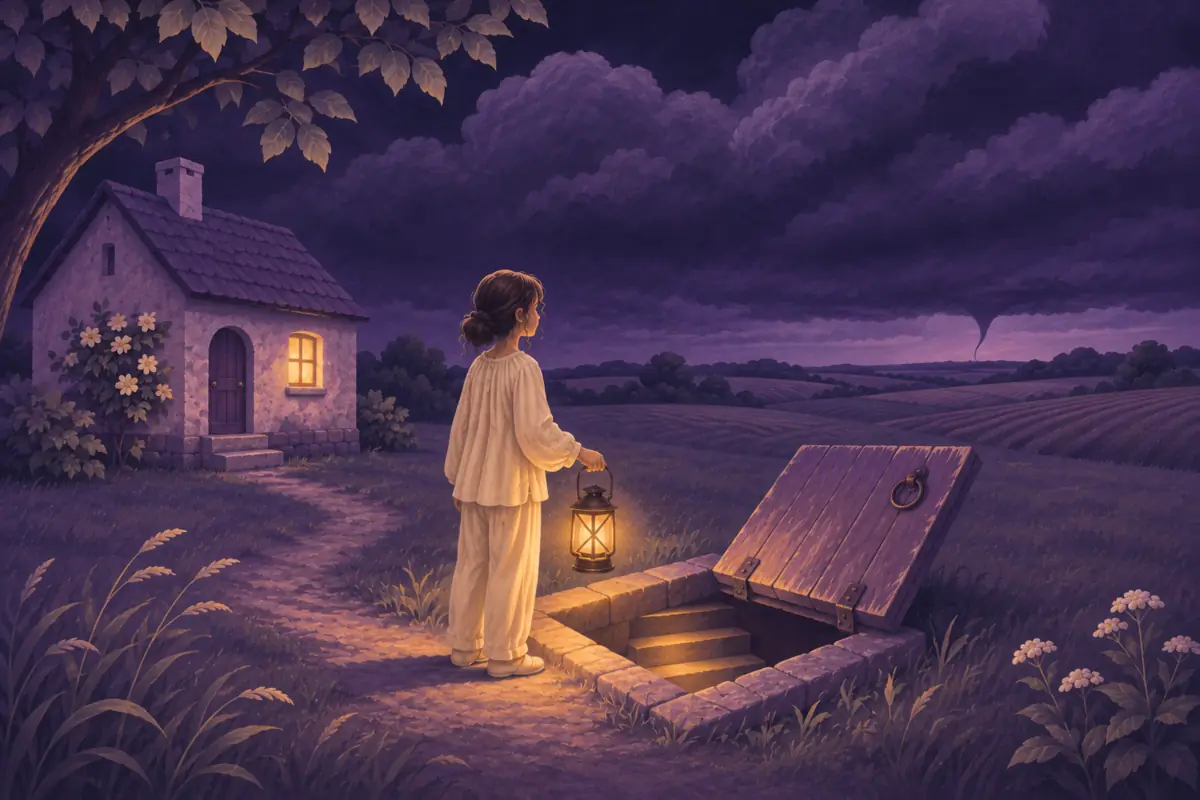
Explore tornado dreams through distant funnels, searching for loved ones, shelter, and aftermath, without treating the dream as a disaster forecast.
A dream about a tornado can center on fast-changing conditions, limited control, the need for shelter, or concern about staying connected to other people. Distance and timing matter: seeing a funnel far away differs from experiencing damage nearby. The dream is not a weather forecast or proof that a personal catastrophe is approaching.
| Scene | Detail that changes the reading | Question to consider |
|---|---|---|
| A funnel appears far away | Observation or expectation | What had actually happened so far? |
| The tornado comes closer | Available time and changing routes | What could I still choose? |
| You search for loved ones | Separation or missing information | What connection mattered first? |
| You find shelter | Access, company, and confidence | What made the refuge feel sufficient? |
| Others dismiss your concern | Different knowledge or refusal | What did I want understood? |
| Several tornadoes appear | Multiple directions or repeated alarms | How did I decide where to focus? |
| You watch from a secure place | Relief, fascination, or concern | Could I remain connected from there? |
| You see the aftermath | Loss, survival, and changed geography | What needed attention now? |
A distant funnel may create anticipation before anything nearby changes. Record its position, the landscape between you, and what made you think it would approach. The dream might show movement toward you, or your certainty might arise without visible evidence.
Your reaction could be fear, fascination, urgency, or calm observation. Did you alert someone, watch for a while, continue another task, or look for a place to go? These choices help distinguish a spectacle from a perceived threat within the scene.
For reflection, separate what was present from what you expected. A personal comparison might involve waiting for an uncertain development, but the dream cannot establish that the worst outcome is likely. A dramatic object on the horizon is still different from damage already occurring. Keeping that distinction visible can make the account more precise without minimizing the feeling it produced.
Approach turns distance into a changing practical problem. Notice what became unavailable as it came closer: a road, a conversation, time to collect something, or the ability to keep everyone together. The narrowing of options may matter more than the storm's appearance.
Did you revise your plan or continue toward an original destination? You might have followed another person, tried to contact someone, or discovered an unfamiliar route. These are narrative details rather than instructions for responding to an actual tornado.
An editorial comparison can concern a deadline or changing situation that reduces time for choice. Use it only if a particular waking context supports the connection. The dream does not mean you are running out of time in life. Ask instead which decision felt urgent, what information was available, and what you still believed you could influence inside the scene.
Searching for someone can become the dream's center even while the tornado remains in the background. Who was missing, and how did you know where they might be? A failed phone call differs from seeing someone across a street or realizing they are already in another location.
Notice whether you needed reunion, confirmation that they were safe within the story, or help making a shared plan. Those goals can lead to different actions. You might feel relief from a short message without physically reaching the person.
For reflection, consider the role of information in care. Wanting contact does not mean you must control another person's movements, and not finding them in a dream does not prove neglect. If the scene recalls an actual concern, communicate about that concern directly. The tornado cannot reveal that someone is in danger or that a relationship is about to be lost.
A refuge may feel reassuring because it is familiar, accessible, shared, or simply accepted as safe within the dream. Describe those qualities separately from the real-world suitability of the place. Dream architecture and dream certainty are not reliable emergency guidance.
Who could enter? You may have opened a door for others, worried about limited room, or arrived to find someone waiting for you. A shelter scene can therefore be about belonging and coordination as well as protection from weather.
A useful personal question is what made support feel available. Did you know how to ask, trust the people there, or need reassurance that you could stay? The dream does not prescribe withdrawal from ordinary life. It may help you describe a specific kind of assistance or pause you value, without assuming that safety requires removing every uncertainty from your surroundings.
The difficulty may lie in making yourself heard rather than in the storm alone. Describe how you tried to communicate and what the others did. Disbelief, distraction, disagreement, and lack of information create different interactions even when they leave you equally frustrated.
Did they see what you saw? A character in another room may have a different view. The dream might also contain an unexplained certainty that you alone understand the situation. Record that certainty as part of the experience rather than evidence that your waking judgment is uniquely accurate.
For reflection, ask what response you wanted: attention, action, confirmation, or shared responsibility. This can connect with an actual communication problem if one exists. It cannot establish that people in your life are dismissive or unsafe. Use real conversations and behavior to assess that possibility, not their assigned roles in an imagined emergency.
Multiple funnels can make direction difficult to choose. Were they separate threats, distant shapes, or repeated appearances as the setting changed? Try to preserve the geography as you remember it, even if it does not form a coherent map.
Your task may have been selecting a route, counting the storms, keeping track of someone, or deciding which change required attention first. The number of tornadoes does not automatically translate into the number of problems in your life. Quantity matters through what it made harder or different.
One comparison could concern competing demands that seem to approach from several directions. Test that idea against the scene: did the tornadoes actually interfere, or were you watching them from a comfortable distance? Keep any fascination or confidence in the account. An interpretation about overwhelm should not erase a dream in which you felt capable or simply interested.
Safety can change the emotional role of a dramatic scene. You may watch with awe, relief, concern for others, or uncertainty about whether the protection will last. Describe what made the place feel secure in the dream without assuming that its real counterpart would provide the same protection.
Did you want to remain there? Perhaps you were comfortable until you saw someone outside, or restless because the storm delayed a plan. Protection can be adequate while the overall experience remains difficult. Conversely, you may have been content to wait.
For personal reflection, distinguish observing from being unaffected. You can remain physically separate within the story while caring about what happens beyond your view. The dream does not make distance a moral failure. A useful question may concern how to stay informed or connected when your immediate role is to wait rather than intervene.
The storm may be gone, leaving a changed neighborhood, scattered belongings, or a route you no longer recognize. What drew your attention first? A surviving object, an absent building, a familiar person, and a practical task create different endings.
Your response could be searching, repairing, documenting, helping, or simply trying to understand the new layout. The dream may contain relief that someone is present alongside sadness about what has changed. Preserve both rather than turning survival into a requirement to feel grateful about everything.
A personal comparison might concern the work after a disruptive period: discovering what remains, deciding what needs attention, and accepting help. The dream does not prove that a crisis has already passed or that loss was necessary for growth. Its ending can remain unfinished. An accurate description of what you encountered is more useful than imposing a complete recovery story.
A tornado dream can feel convincing because everyone seems to know what is happening without explanation. After waking, separate that sense of certainty from the observable details. “I knew it would hit the house” and “I saw it hit the house” describe different remembered events.
NightAtlas's agency framework asks what you intended, what action was available, what obstructed it, and what result followed. You may have had little influence over the weather but meaningful choices about communication or company within the scene. Recognizing those choices does not minimize fear or declare that you controlled the outcome.
Try tracking one emotional turn. Perhaps you became calmer when another person joined you, or more distressed when a familiar door would not open. That specific change can reveal what mattered in the story more clearly than a broad label such as chaos. It also leaves room for a dream that combines fear with curiosity or competence.
Domhoff discusses links between waking concerns and dream content in Finding Meaning in Dreams, chapter 8.
For your own account, consider recognizable sources: recent weather reporting, a film, a remembered storm, a photograph, or a conversation about emergency planning. Such associations do not make the dream trivial. They may explain a particular shape or location while leaving its emotional sequence open to reflection.
This guide does not support a prediction of weather or personal disaster. It also gives no basis for declaring the funnel a divine warning or proof of a hidden psychological condition. This guide's scenarios are editorial possibilities. If you need information about actual weather, use current forecasts and official alerts; the dream is a different kind of experience.
No. The scene does not forecast weather or establish that your life is about to be disrupted. Strong fear and vivid imagery are parts of the dream experience, not independent evidence of a future event. Use real information to assess any actual concern that comes to mind afterward.
That may be a personal comparison, but the number alone cannot establish it. Ask what the multiple funnels changed: your route, attention, ability to find someone, or nothing at all. A scene watched with fascination differs from one in which every direction appeared blocked. Preserve that distinction.
Describe what supported your calm: a plan, a familiar place, trust in someone, distance, or no obvious reason. The dream does not prove superior judgment or emotional detachment. Other characters' reactions may simply create contrast. Focus on your actual goal and how the different responses affected coordination.
It means you found refuge within the remembered scene. The relief can be meaningful without certifying resolution in waking life. Ask what remained uncertain after you arrived and what made the shelter feel adequate. That detail may help you name useful support rather than declare an entire problem finished.
Educational reflection only. Interpretations are not diagnoses, evidence about other people, or predictions.
Atlas has already read this article.
Explore eight police dream scenes through help, authority, questioning, and responsibility, while keeping personal experience ahead of a fixed meaning.

Explore eight shooting dream scenes through uncertainty, responsibility, sound, and the remembered aftermath, without inferring intent or predicting harm.

Explore eight non-graphic killing dream scenes through intention, responsibility, witnessing, and regret, without treating the dream as proof of desire.



Short quizzes about your dreams.
Write down dreams before they fade.
What NightAtlas is and how it works.


