

Dream About Police: Help, Rules, and Being Heard
Explore eight police dream scenes through help, authority, questioning, and responsibility, while keeping personal experience ahead of a fixed meaning.
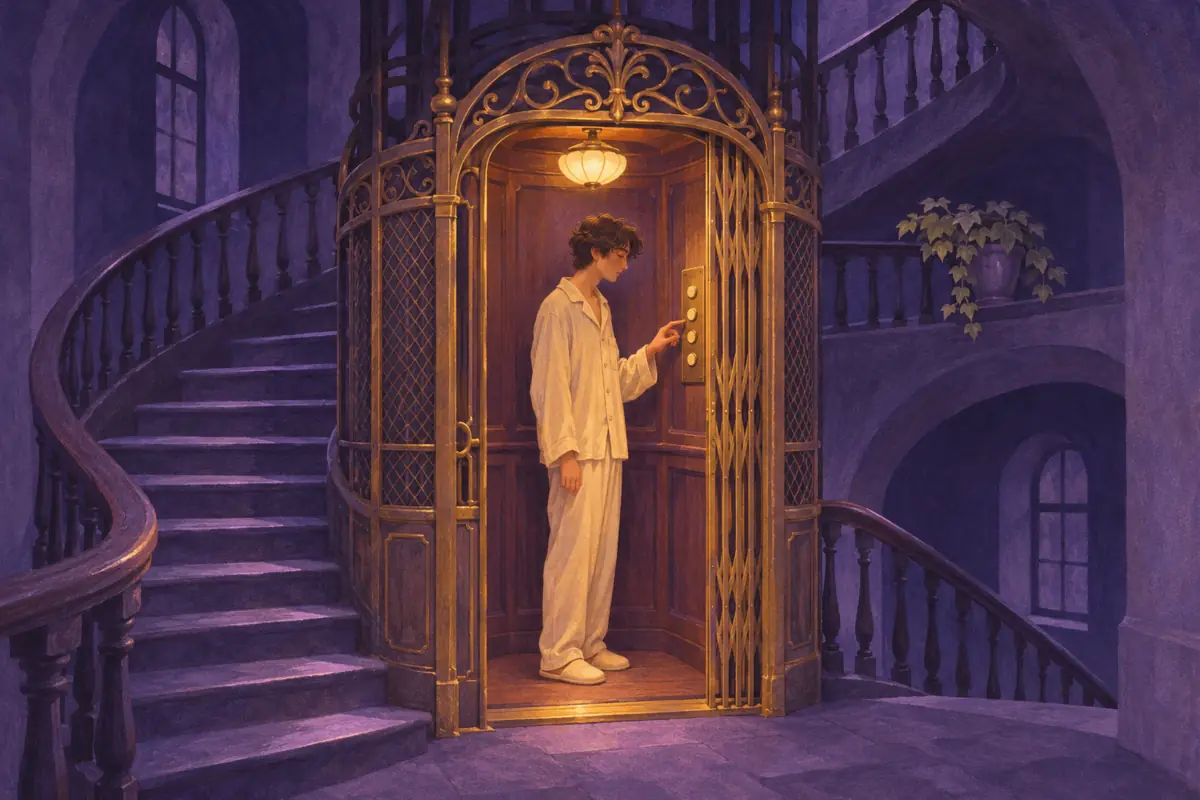
Explore eight elevator dream scenes, including missed floors, closed doors, sudden drops, and shared rides, through destination and available control.
A dream about an elevator may focus on changing position, sharing a confined space, or depending on a mechanism to reach your destination. Ask whether you could choose the floor, stop, or leave. Its movement does not predict career advancement or decline, and an elevator has no fixed ancient dream meaning.
| Scene | Detail to preserve | Question to consider |
|---|---|---|
| Stuck between floors | Communication and company | What could I do while waiting? |
| Traveling to the wrong floor | Your choice and the mechanism's response | Was my request understood? |
| A sudden drop | Sensation and attempted response | What support changed? |
| Doors will not open | Arrival without access | What still separated me from the destination? |
| Riding alone | Privacy versus isolation | Did I want company? |
| A crowded car | Room, pace, and shared decisions | Whose destination shaped the ride? |
| Impossible movement | Surprise versus fear | How did the changed rules affect me? |
| Missing the elevator | Delay, separation, or relief | Did I still want to take it? |
A stalled elevator creates waiting without the usual option of stepping into a hallway. Record whether the pause is explained, whether you can contact anyone, and whether another person is with you. Those details shape the scene more precisely than a general label of being trapped.
What do you try? Pressing a button, talking with a companion, listening for movement, and simply sitting down represent different responses. An inability to restart the mechanism does not mean you did nothing.
A possible waking association concerns depending on a process you cannot speed up. It should account for the feeling: panic, irritation, patience, or unexpected intimacy with another passenger. The dream does not establish that your life has stalled. It gives you a particular delay, in a particular space, with a particular set of actions available while the outcome remains uncertain.
Separate the request from the response. Did you press the wrong button, find the labels unreadable, or clearly choose a floor that the elevator ignored? Each version creates a different relationship between intention and movement.
The destination matters too. An unfamiliar floor can feel threatening, intriguing, or merely inconvenient. If you decide to explore, the scene changes from unwanted transport to a new choice after arrival.
A possible reflection concerns instructions that do not produce the expected result. It does not prove that someone is directing your life against your wishes. Notice whether another passenger chose the route or whether the mechanism seemed to act independently. You may have a chance to correct the trip, ask for information, or leave. Preserve those options rather than reducing the entire scene to loss of control.
The remembered sensation may be more vivid than any visible event. Describe whether you saw floor numbers fall, felt a downward rush, or simply knew the car was dropping. These are different details, and you do not need to add a crash if none occurred.
What was your immediate intention? Holding a rail, reaching for someone, pressing a button, or bracing yourself each directs attention differently. Concern for another passenger may be as central as fear for yourself.
A possible metaphor involves support changing without warning. It remains a comparison, not a prediction of failure or a real accident. Also preserve the ending accurately. The car may stop, the movement may become playful, or you may wake before anything resolves. A frightening middle does not require an invented catastrophic conclusion to justify how intense the scene felt.
Reaching the right floor can make the remaining barrier especially frustrating. You may see the number you wanted, hear people outside, or glimpse the destination through a gap. The distinction is between movement completed and access still unavailable.
Who can influence the doors? Another passenger, someone in the hallway, or a button that does not respond may become important. If people leave without noticing you, the scene can add a social dimension to a mechanical obstacle.
A personal association might concern doing the required steps but still waiting for permission or connection. The dream cannot establish that an actual institution is excluding you. Keep the practical details: what would opening the doors allow you to do, and what did you try? Arrival is not always the same as participation, and the scene may make that difference memorable.
An empty elevator can offer privacy, quiet, or an uncomfortable sense that no one would notice a problem. Begin with whether solitude was welcome. The absence of other passengers does not automatically mean loneliness.
What occupies your attention? A mirror, music, floor numbers, or the view through glass may shape the experience. You might enjoy a brief pause between activities or feel uneasy because the ride takes longer than expected.
A possible question concerns moving between roles without company. Yet the scene may simply recall an ordinary solitary ride. Notice whether you wanted anyone to join you and whether you could leave at the next stop. A peaceful transition deserves to remain peaceful. There is no need to add an interpretation about isolation merely because a small enclosed space sounds unsettling when described afterward.
A shared ride may involve physical closeness, negotiated space, and multiple destinations. You might be unable to reach the buttons, stand near someone familiar, or feel responsible for holding the door. These details give the crowd a practical role.
Are people cooperative? A passenger making room or pressing your floor creates a different scene from someone ignoring your request. The ride may involve support as readily as restriction.
A waking comparison could concern a shared process whose pace and stops are not yours alone to choose. Avoid interpreting every crowded elevator as social pressure. Ask which part felt difficult: space, attention, delay, or uncertainty about when you could exit. If the group was friendly, the scene may center on brief companionship. The number of passengers matters through what it changes for you.
Impossible movement can be frightening or delightful depending on your expectation. The car may travel along a corridor, pass through open air, or become a different vehicle. Describe the transition without correcting it into realistic mechanics.
What happens to your destination when the rules change? You may keep trying to reach the same floor or become interested in the new route. A change from alarm to wonder is worth preserving.
A possible reflection concerns discovering that a familiar system behaves differently than expected. It does not have to mean instability. If the movement gives you an extraordinary view, possibility may be a better question than danger. The scene's impossibility is not evidence of a hidden supernatural event; it is part of the experience you remember and can explore through its effect on your choices.
Missing the ride can involve separation, inconvenience, or relief. Who or what is inside when the doors close? Being left behind by friends differs from watching an empty car depart when you were unsure you wanted to enter.
Notice whether another route is available. Waiting for the next car, taking stairs, or deciding not to go can each reshape the scene. If someone blames you for the delay, the social exchange may matter more than the missed elevator.
A possible analogy concerns timing and coordination. It does not establish that a real opportunity has passed forever. The dream may give you another chance immediately or leave the wait unresolved. Ask whether you still wanted the destination after missing the ride. Sometimes the interruption clarifies a preference; sometimes it is simply an unwanted delay.
An elevator offers a compact way to distinguish what you request from what happens. Write the requested floor, actual movement, obstacles, and outcome on separate lines. This prevents the mechanism's behavior from being mistaken for a statement about your own competence.
Then consider who shares decisions. A passenger can choose a stop without choosing every turn of the journey. Someone else may help reach a button or hold a door. Control can be distributed rather than entirely present or absent.
The destination makes these questions personal. An elevator to your apartment, a meeting, a hospital ward, or an unknown rooftop carries different stakes. Interpreting only the direction loses that context and can turn an ordinary transport image into an unsupported prediction about status.
If the ride reminds you of work or a relationship, identify the precise similarity. Is it waiting on a system, sharing a small space, being taken somewhere unexpected, or having help with a request? Those are distinct possible connections.
A direct memory may also fit: a building you use, a recent delay, or a film scene. You do not need a hidden code to make the dream worth describing.
Claims that an elevator forecasts promotion, demotion, or spiritual rank go beyond the scene. It is a modern mechanism within a particular dream story, not an ancient universal sign. Your own associations can be explored without giving the image authority to decide what happens next.
No. Upward movement is part of the dream's route, not information about a future career decision. Consider the actual destination and your feeling about reaching it. A work-related metaphor may fit your circumstances, but it needs that context and cannot guarantee an outcome.
Keep the remembered ending intact. A sudden drop, an eventual stop, and waking before resolution are different sequences. You can explore the feeling of changing support without adding a disaster that did not occur. The dream does not predict a real elevator accident or personal failure.
The scene may suggest a question about waiting or dependence on a process, but it cannot establish a verdict about your life. Notice what you could do while the car was stopped and whether the delay felt frustrating, frightening, neutral, or even welcome in the dream.
The changed rules may have offered surprise, a view, movement, or an adventure you welcomed. Preserve that enjoyment rather than forcing a reading about lost control. Your response helps distinguish an exhilarating scene from a threatening one, even when both contain the same unusual movement.
Educational reflection only. Interpretations are not diagnoses, evidence about other people, or predictions.
Atlas has already read this article.
Explore eight police dream scenes through help, authority, questioning, and responsibility, while keeping personal experience ahead of a fixed meaning.

Explore eight shooting dream scenes through uncertainty, responsibility, sound, and the remembered aftermath, without inferring intent or predicting harm.

Explore eight non-graphic killing dream scenes through intention, responsibility, witnessing, and regret, without treating the dream as proof of desire.



Short quizzes about your dreams.
Write down dreams before they fade.
What NightAtlas is and how it works.


