

Dream About Police: Help, Rules, and Being Heard
Explore eight police dream scenes through help, authority, questioning, and responsibility, while keeping personal experience ahead of a fixed meaning.
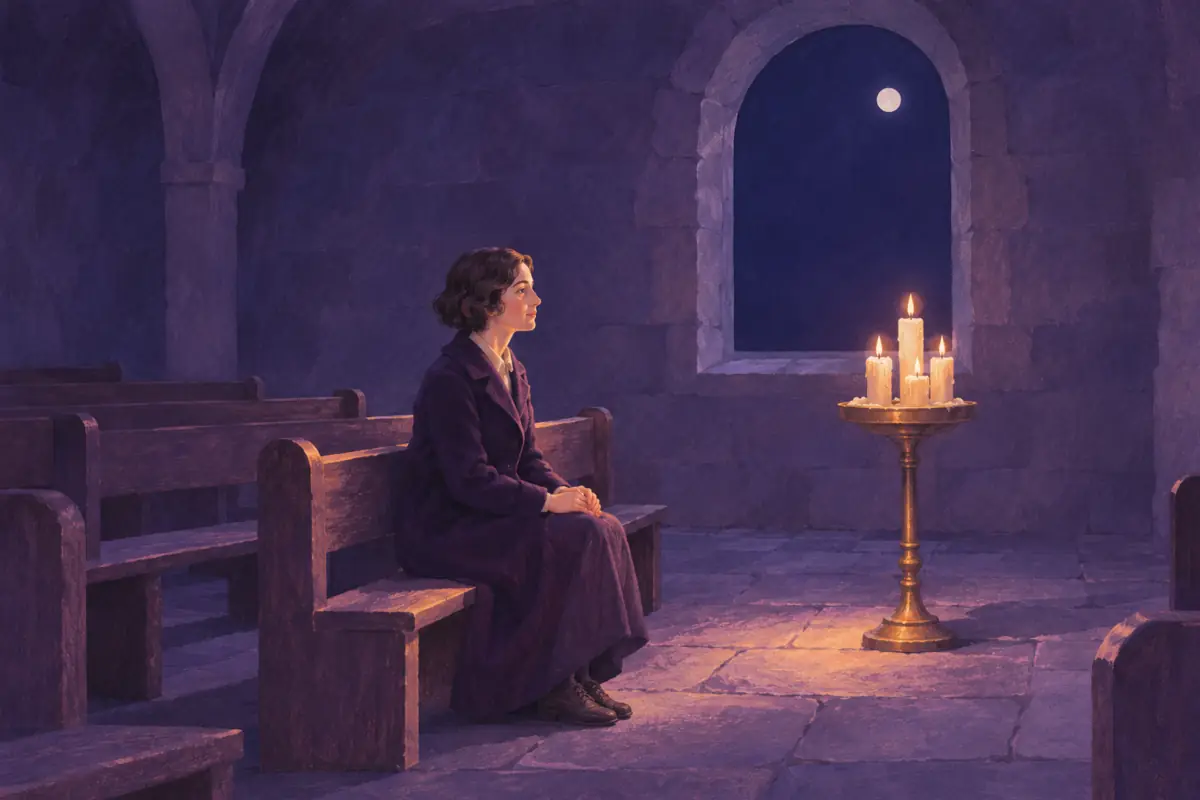
Explore eight dreams of churches or temples through your own religious history, community, silence, ritual, access, and the feelings the setting evokes.
A dream about a church or temple may involve community, ritual, moral questions, silence, or your relationship with a particular religious history. The setting's personal meaning matters more than a generic label. The dream does not establish divine approval, punishment, or an obligation to adopt, change, or abandon a faith.
| Scene | Detail that changes the reading | Question to explore |
|---|---|---|
| Praying or addressing someone | Chosen words and expected response | What was I seeking? |
| Being denied entry | Who set the rule and why | Did exclusion feel familiar or surprising? |
| An empty sanctuary | Welcome quiet versus absent community | What had I expected to find? |
| A shared ceremony | Participation versus observation | Did I understand my role? |
| An unfamiliar tradition | Recognized details versus uncertainty | What did I know, and what did I assume? |
| Returning to a childhood place | Present identity and remembered role | How did the return feel? |
| Repairing or cleaning the building | Care for a place versus assigned duty | Why did preserving it matter? |
| Choosing to leave | Completion, discomfort, or freedom | What did leaving change? |
Begin with the act you remember. You may speak familiar words, improvise a request, sit silently, or attempt to pray without knowing what to say. Those experiences should not be treated as interchangeable simply because they occur in a religious building.
What did you seek: comfort, permission, forgiveness, help for someone, or an answer? If you remember a response, record its words separately from your later interpretation. A feeling of reassurance and a clearly spoken statement are different kinds of dream detail.
The scene may invite reflection on how you ask for support or what matters enough to bring into prayer. It does not verify the source of any dream response. You can respect the experience's spiritual importance within your beliefs while distinguishing that importance from a claim that the dream establishes divine instructions for you or for someone else.
Exclusion becomes specific through the person, rule, and entrance involved. A locked door differs from an attendant refusing entry or a group acting as though you do not belong. Did anyone explain what was required, and did you accept that requirement?
Your feeling may involve shame, anger, grief, or relief at not having to participate. Those reactions lead toward different questions. An outside observer might assume rejection hurt, while the dream itself may have made departure welcome.
A possible connection concerns membership, recognition, or access to a valued community. It is not evidence that a real religious group rejects you, nor a verdict about spiritual worth. Notice whether you wanted the place, the people inside, or the opportunity to do something there. Losing access to those three things can carry quite different personal meanings.
Silence may be what you came for, or it may make the absence of others feel sharper. Describe your expectation before deciding whether the scene concerns peace or abandonment. A place prepared for a gathering that never arrives differs from one you intentionally visit alone.
You might sit, explore, wait, or call out. These actions show your relationship to the quiet. If the architecture absorbs your attention, the scene may involve appreciation of a place rather than a search for religious guidance.
A personal reflection could concern the difference between private meaning and shared support. But you do not need to infer a loss of faith because no congregation appears. Nor does calm silence prove spiritual progress. Keep the emotional tone and your purpose visible, especially if the same empty room felt comforting at one moment and lonely at another.
Record only the ritual details you actually recognize. A song, gesture, procession, meal, or spoken phrase may locate the scene within your own experience. If the ceremony is unfamiliar or mixed, say that rather than assigning it to a tradition based on a vague resemblance.
Did you know when to stand, speak, or remain quiet? Confidence in your role can feel like belonging; uncertainty can feel awkward, curious, or welcome if someone helps you participate. The response of other people matters.
A possible question concerns how individual feeling meets a shared practice. You might enjoy the gathering while feeling distant from its meaning, or feel deeply moved while standing apart. The dream does not require you to resolve those layers into a single statement about belief. Describe what you joined voluntarily and what you felt expected to do.
The central experience may be being a guest. You might admire the space, wonder how to behave, seek guidance, or fear making a mistake. Identify what you knew within the dream and what remained uncertain.
Avoid filling gaps with assumptions after waking. Clothing, architecture, or a single object may not be enough to identify the tradition. A dream can combine details without representing any actual community accurately.
For reflection, ask how you responded to not knowing. Did you observe, ask permission, copy others, or leave? This can be a question about curiosity and respect rather than a message that you should change religions. If you later explore an identifiable tradition, its own sources and practitioners provide context the dream cannot supply. Your remembered visit is evidence of your experience, not an account of what that community teaches.
A familiar doorway or sound can make the return feel immediate even when the building has changed. Notice whether you arrive as your present self or are treated as the child you once were. That difference can shape your relationship to the people and rules inside.
Who recognizes you? A remembered leader, relative, or friend may evoke a particular relationship rather than the whole tradition. Warmth, unease, gratitude, and distance can coexist without requiring a final judgment about your past.
A useful question concerns what you wanted from the return: reconnection, explanation, a familiar quiet, or the chance to leave differently. The dream does not establish that you must restore an old practice or reject it. Keep the specific memories separate from conclusions about every part of your religious history, especially when the encounter feels emotionally mixed.
Practical work can express care for a place without resolving what you believe. You may mend a door, remove dust, arrange seats, or try to protect a damaged object. Name the task and why it mattered within the scene.
Was the work chosen or assigned? Volunteering alongside others differs from being left alone to restore an enormous building. If no one acknowledges your effort, the relationship between contribution and recognition may become central.
A possible reflection concerns preserving something you value, including a community memory or a place of refuge. It does not follow that damage represents spiritual corruption or that you are responsible for repairing a group. Notice the scale of the task and available help. A small completed repair may feel satisfying even when the whole building remains unfinished, and the dream need not demand more from you.
Leaving can be the natural completion of a visit, a response to discomfort, or an assertion of choice. Establish which version occurred before calling it a break with faith. You may intend to return, or simply need air after a crowded gathering.
Notice whether anyone tries to stop you, accompanies you, or remains unaware of your departure. Those responses can make the scene about permission, loyalty, privacy, or an ordinary transition between places.
What lies outside? A familiar street creates a different ending from darkness, a celebration, or someone waiting for you. A possible personal question concerns carrying meaning beyond an institution or choosing the conditions of participation. The dream cannot decide your religious commitments. It can help you describe how staying and leaving felt, including relief that does not cancel affection for the place you left.
Use the name of the actual place or community when you know it. “My grandmother's church” contains personal context that “a temple” may lose. If the setting was invented or mixed, that uncertainty also belongs in the account.
The questions in this guide concern access, participation, memory, and feeling. They do not claim that different religious traditions share one doctrine of dreams. A scene involving prayer should not automatically be translated into a secular metaphor, and a scene involving architecture should not automatically be declared a revelation.
You can hold your own interpretation within your beliefs while keeping its scope clear: this is how the experience matters to you. It does not authorize instructions about what another person must believe or establish supernatural facts that others are obliged to accept.
List the actions you could take: enter, ask, observe, participate, remain silent, or leave. Then note which were welcomed or restricted. This can clarify whether the remembered scene emphasized belonging, authority, or private reflection.
An inability to speak does not automatically mean a lack of faith; it may simply be a frustrating event within the dream. Voluntary silence can mean something very different. Intention and outcome deserve separate descriptions, especially in a setting where familiar rules may carry emotional weight.
The dream itself cannot establish the source of the experience. You may understand it through your own faith and find it meaningful. Keep that personal interpretation distinct from verified instruction, especially when considering major decisions or telling other people what they are required to do.
No. A dream scene cannot determine your worth or divine standing. Exclusion may invite reflection on belonging, authority, or a remembered experience, but those are possibilities. Identify who denied access and how you felt before drawing conclusions about a religious community or yourself.
The setting may relate to curiosity, a remembered image, a visit, or something you cannot identify clearly. The dream does not require conversion or claim expertise about that tradition. Preserve uncertain details and consider how you felt as a visitor rather than assigning a universal meaning to the building.
Yes. It may be the end of a visit or movement to another place, with no felt conflict about belief. Check the actual reason for leaving and whether you expected to return. A dramatic interpretation about abandoning faith would not fit every ordinary departure.
Educational reflection only. Interpretations are not diagnoses, evidence about other people, or predictions.
Atlas has already read this article.
Explore eight police dream scenes through help, authority, questioning, and responsibility, while keeping personal experience ahead of a fixed meaning.

Explore eight shooting dream scenes through uncertainty, responsibility, sound, and the remembered aftermath, without inferring intent or predicting harm.

Explore eight non-graphic killing dream scenes through intention, responsibility, witnessing, and regret, without treating the dream as proof of desire.



Short quizzes about your dreams.
Write down dreams before they fade.
What NightAtlas is and how it works.


