

Dream About Police: Help, Rules, and Being Heard
Explore eight police dream scenes through help, authority, questioning, and responsibility, while keeping personal experience ahead of a fixed meaning.
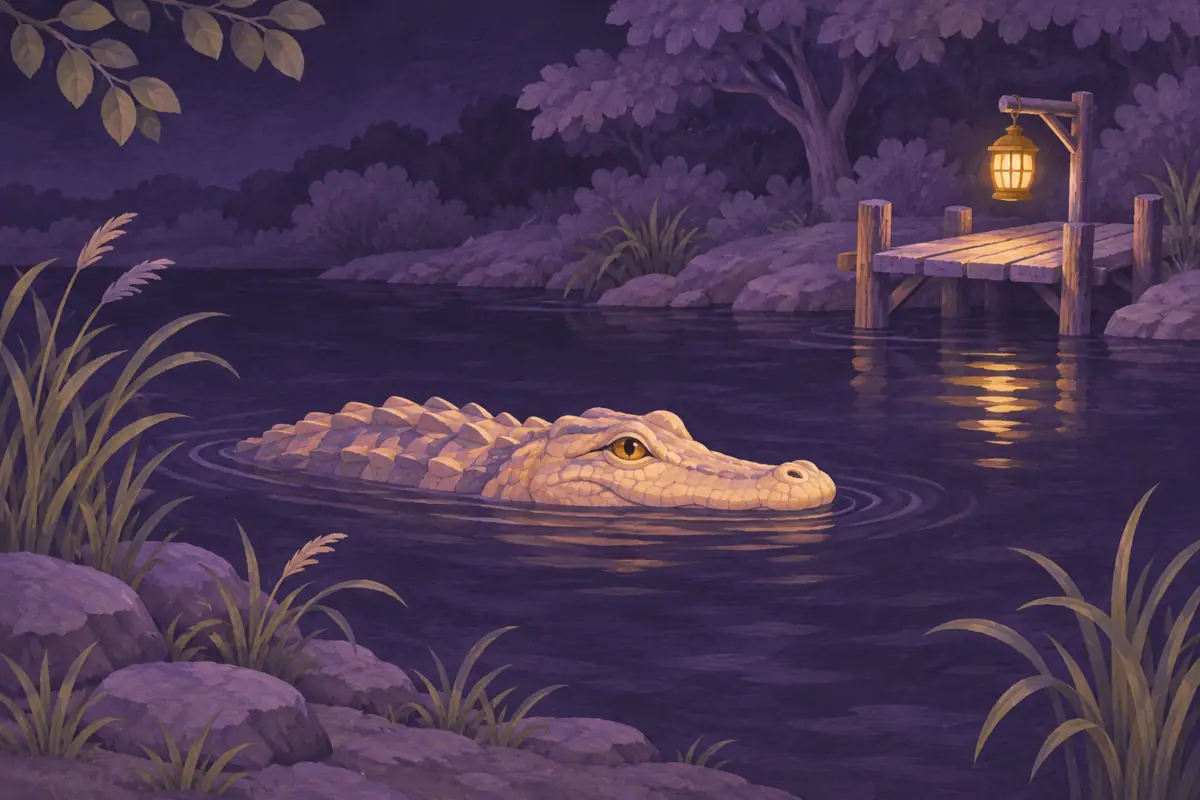
Read crocodile dreams through eight scenes involving stillness, pursuit, water, unexpected protection, and the boundaries that mattered to you.
A dream about crocodiles may bring attention to uncertainty, a boundary you hesitate to cross, or power that seems quiet until it moves. Begin with the animal's behavior and your available route. A crocodile does not prove deception, identify an untrustworthy person, or predict danger beyond the dream.
| Encounter | Important contrast | Reflection question |
|---|---|---|
| A motionless crocodile | Resting versus waiting | What made stillness uncomfortable? |
| Eyes above water | Partial view versus complete certainty | What remained unknown? |
| A blocked crossing | Necessary passage versus optional route | Did I have another way? |
| A chase on land | Pursuit versus imagined pursuit | When did movement begin? |
| Inside your home | Unexpected presence versus damage | Which room mattered? |
| A protective crocodile | Protection versus restriction | Could I choose to leave? |
| Holding a small crocodile | Care versus underestimating responsibility | Why was I holding it? |
| A crocodile leaves | Restored distance versus unfinished watchfulness | Did the boundary feel secure? |
Stillness can be the most tense part of the encounter. You may be waiting for movement, unsure whether the animal has noticed you, or watching others walk past without concern. Describe the source of the tension. An open eye is an observed detail; “it was planning to attack” is an understanding you had within the dream.
Ask what you wanted to accomplish while the crocodile remained there. Perhaps you needed to retrieve a bag, cross a path, or wait for a friend. The practical task can explain why simply walking away did not feel available.
As a personal metaphor, the scene might resemble waiting around a sensitive issue. It might equally be a vivid wildlife observation. If nothing moved and you felt fascinated, preserve that patience. Quietness is not automatically disguised aggression, even when the animal's reputation encourages that reading.
A partial view invites you to imagine the rest. Write down whether the water was muddy, dark, reflective, or simply deep. Those qualities establish how much information the dream gave you. Counting many pairs of eyes creates a different problem from trying to decide whether one floating shape is alive.
Your response may center on uncertainty: asking someone to look, stepping closer, or refusing to approach. If another character dismissed your concern, note what they actually said rather than assuming they intended to deceive you.
The useful question is how you handled an incomplete view. You might recognize a current situation in which you want more information before proceeding. That parallel does not mean danger is present. An interpretation should leave room for the fact that part of the scene stayed unknown, instead of filling every gap with a threatening explanation.
The crossing introduces a destination. Where were you going, and why did arrival matter? Reaching home, joining a group, and exploring the opposite bank give the obstacle different emotional weight. A crocodile between you and something optional does not create the same dilemma as one between you and someone waiting for help.
Look for the routes you considered. You might search for a bridge, wait for the animal to move, or be urged to jump. Pressure from other people can become the central feature when the danger itself stays still.
This scene can support a question about permission to choose another route. It does not require a heroic interpretation in which you must confront whatever frightens you. In a journal, distinguish “I wanted to cross” from “I felt I had to cross.” That wording can clarify the encounter without prescribing a waking decision.
Land may initially appear to solve the problem, then fail to provide the safety you expected. Record that turning point. Did you leave the water and relax before noticing pursuit, or did the chase begin entirely on dry ground? The story changes depending on whether a refuge failed or never existed.
Your route also matters. Running toward a building, climbing, hiding, and helping another person move all reveal different priorities. An obstacle such as a locked gate can become more important than the animal following you.
Avoid treating escape as a test of personal strength. Dream geography can change without warning, and effort does not guarantee a controllable outcome. If a waking connection fits, it might concern a problem that follows you across settings. Keep that connection provisional, and name the actual problem rather than using the crocodile as proof that someone is pursuing you.
An animal beside the kitchen table may feel different from one in a bathtub or behind a bedroom door. The room tells you what ordinary activity became difficult. Cooking, resting, and washing involve different expectations about privacy and access.
Did the crocodile damage anything, or was its presence enough to make the room unusable? That distinction helps separate intrusion from destruction. You may have been negotiating where everyone could stand rather than experiencing an attack.
Other people's reactions can sharpen the scene. Perhaps a family member treated the animal as a pet while you wanted it removed. The possible theme then becomes a disagreement about what belongs in shared space. It still cannot show that a real household member is dangerous. Begin with your own experience of the room, the rule that seemed changed, and the action you wanted to take.
A protective crocodile complicates the usual frightening image. It might stand between you and another animal, carry you across water, or prevent someone from approaching. Describe the help before asking what the creature symbolizes. Protection is a relationship in the scene, not a quality established by its species.
Then consider whether the protection felt welcome. A guard that will not let anyone near you can become restrictive, while an animal that creates space and then leaves may feel reassuring. Your ability to accept, refuse, or leave matters.
A possible question concerns support that arrives in an unfamiliar form. Another concerns the price of being protected. Neither requires you to assign the crocodile to a person. You can hold both gratitude and discomfort in the same account, especially if the dream never settled whether you were sheltered or confined.
Size changes the immediate encounter without necessarily explaining it. A tiny crocodile in your hands may seem fragile, entertaining, or unexpectedly demanding. Why were you responsible for it? Finding an abandoned animal differs from choosing it as a pet or being handed it by someone who disappears.
Notice the task: feeding it, carrying it, finding water, or preventing it from biting. These details give care a practical shape. If the animal grew suddenly, the change in responsibility may matter more than its original smallness.
You might associate the scene with a commitment that seemed manageable at first. Check whether that comparison fits the feeling. Delight in caring for a strange creature deserves as much attention as regret. The dream does not predict that a new project will become dangerous; it offers a scene in which expectations and responsibilities can be compared.
Watching the animal leave can restore a boundary: you remain here, and it belongs elsewhere. But the ending may also feel uncertain if you can no longer see where it went. Describe whether disappearance brought relief or made you more watchful.
Your role in the departure matters. Opening a gate, waiting quietly, and chasing the crocodile away involve different amounts of intervention. If someone else managed the situation, note how you felt about accepting their help.
A useful question is what counted as enough resolution. Did you need the animal gone, a safe path reopened, or certainty that it would never return? The last demand may be impossible inside the story, but that does not invalidate the relief you felt. Do not convert an unfinished ending into a prediction that a waking problem will reappear. Sometimes the remembered account simply stops at the water's edge.
Draw a rough map if the setting remains clear: water, bank, door, route, animal, and your position. Mark the place you wanted to reach. This small exercise can reveal whether the central problem was closeness, blocked movement, or an uncertain boundary.
Next label the feeling at two moments. You might have been calm while the crocodile was visible and frightened after it vanished. In that case, uncertainty may deserve more attention than proximity. Or you may have felt anxious until it came close enough to recognize as familiar.
NightAtlas's agency framework separates your intention, attempted action, obstacle, and outcome. Applying those categories here is an editorial reflection method, not a psychological assessment. “I searched for another path” describes what you did. “I am a person who avoids conflict” is a much larger conclusion that the scene cannot establish.
A personal association makes a different claim from a rule attributed to a culture. “This reminds me of a tense meeting” is your comparison. “Crocodiles mean dishonest people” turns a comparison into an unsupported rule. Keeping the first phrasing makes room for another explanation.
Start with familiar sources of the image: an animal encounter, a children's story, an image in a game, or a conversation about rivers. You do not have to choose a symbolic reading when a direct association feels more relevant.
A frightening or impressive encounter is not enough to identify a religious or Indigenous meaning. If a particular tradition matters to you, identify the actual story or source you know. An impressive animal can hold spiritual significance in your reflection without supplying evidence about another person's intentions or your future.
No. The dream cannot establish deception by a real person. If distrust was part of the scene, describe the feeling and the details that produced it. Any waking concern about honesty should be evaluated through actual conversations and behavior, independently of the animal in your dream.
Then stillness belongs at the center of the account. Ask whether you were waiting, observing, or changing your route because of what might happen. A motionless animal can create tension without doing anything. That difference helps you avoid remembering an anticipated attack as an event that occurred.
You can use questions about boundaries, visibility, and movement for either animal, while preserving whichever name you remember. Do not invent identification details after waking. Personal familiarity with one animal may matter more to your interpretation than a general comparison between the two species.
It describes a successful escape within that dream, not a forecast. You can appreciate the relief and notice the actions that became available. Whether the scene connects to a waking challenge depends on your circumstances; the ending cannot guarantee the result of an unrelated decision or effort.
Educational reflection only. Interpretations are not diagnoses, evidence about other people, or predictions.
Atlas has already read this article.
Explore eight police dream scenes through help, authority, questioning, and responsibility, while keeping personal experience ahead of a fixed meaning.

Explore eight shooting dream scenes through uncertainty, responsibility, sound, and the remembered aftermath, without inferring intent or predicting harm.

Explore eight non-graphic killing dream scenes through intention, responsibility, witnessing, and regret, without treating the dream as proof of desire.



Short quizzes about your dreams.
Write down dreams before they fade.
What NightAtlas is and how it works.


