

Dream About Police: Help, Rules, and Being Heard
Explore eight police dream scenes through help, authority, questioning, and responsibility, while keeping personal experience ahead of a fixed meaning.
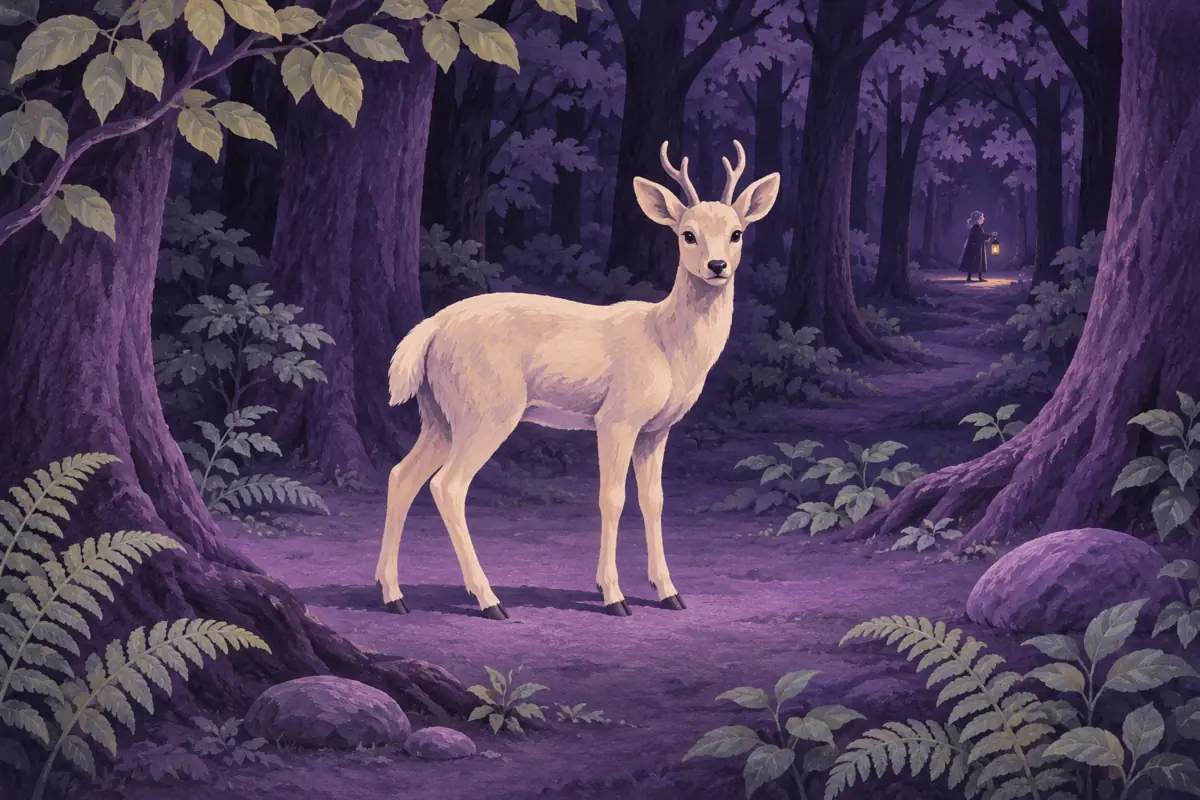
Explore deer dreams through eight scenes, from a watchful animal to a tangled stag, with questions about distance, trust, and care.
A dream about deer can invite reflection on cautious contact, beauty, vulnerability, or the wish to approach something without disturbing it. The encounter matters more than a fixed animal meaning. A deer watching from the trees, accepting your presence, or running away creates a different question about distance and trust.
| Scene | Useful distinction | Reflection question |
|---|---|---|
| A deer watches you | Welcome attention or scrutiny | Who needed reassurance? |
| It runs away | Pursuit or a quiet departure | Did closeness require permission? |
| You follow it | Invitation or assumption | Could you choose another route? |
| An injured deer | Possible help or helpless watching | What was within reach? |
| Antlers become tangled | Beauty, weight, or obstruction | What made movement difficult? |
| A deer enters your home | Delight or an unsuitable setting | Who needed more space? |
| A fawn appears alone | Observed separation or assumed abandonment | What did you actually know? |
| A herd crosses your path | Interruption or shared movement | Could you pause comfortably? |
A motionless deer can make a dream feel unusually quiet. Describe the distance, the direction of its gaze, and what you were doing before noticing it. There is a difference between being watched while passing through a forest and discovering an animal already standing beside your bed.
Your own stillness deserves equal attention. Perhaps you wanted the encounter to last. Perhaps you feared that any movement would spoil it. Or perhaps the gaze felt uncomfortable, as though you had become visible before deciding whether you wanted attention.
A useful personal question concerns contact that does not need to become possession. Could you appreciate the animal without approaching it? If the answer was yes, the scene may be remembered as enough in itself. There is no requirement to turn a quiet meeting into a hidden warning, a spiritual assignment, or a test you were expected to pass.
Reconstruct the approach rather than starting with the escape. Were you reaching out gently, trying to take a picture, chasing the animal, or simply walking in its direction? Your intention and the result may have differed without either being mysterious.
Disappointment can be central here: you wanted a moment of connection and could not control whether it continued. Alternatively, you may have felt relieved that the deer was able to leave. That difference matters more than a generic interpretation about missed opportunities.
If the scene recalls a waking relationship, focus on the question of pace. Wanting contact does not determine another person's readiness for it. This is an optional analogy, not evidence that anyone is rejecting you. Keep the deer as an animal in your description before assigning it a human identity. Its departure might also be the ordinary end of an imagined wildlife encounter.
Following may feel voluntary, irresistible, or accidental. Did the animal look back and wait, or did you decide that its movement was an invitation? That small distinction separates an observed interaction from a meaning you supplied within the dream.
Notice the route. A familiar trail may make the journey comfortable, while crossing a boundary into dense woods may introduce uncertainty. You may have trusted the deer but disliked the destination. You may have stopped following without any conflict at all.
For reflection, ask what made the guide seem trustworthy: familiarity, calm behavior, beauty, or simply the dream's certainty. A vivid feeling of being guided does not establish an external message. You can still value the experience and ask whether you currently want direction, company, or permission to explore. An unfinished journey need not contain a missing revelation you must recover.
The injury can shift your attention from admiration to responsibility. Record whether you saw what happened or only discovered the animal afterward. Do not fill an uncertain gap with a story about blame. Your remembered concern may be clearer than the cause of the injury.
What help seemed possible? You might have called someone, kept other people away, searched for a path, or remained beside the animal. These are different forms of involvement, even if none changed the outcome. Wanting to help and knowing how are separate things.
The scene may raise a question about care under limited conditions. It does not make you responsible for a real person's suffering, and an unresolved ending does not prove failure. If the animal resembled one from a recent news story or encounter, that concrete association may matter more than a metaphor about your own vulnerability.
Antlers may first appear impressive, then become awkward when the animal tries to move through a doorway, branches, or fencing. The change is important: something visually striking becomes a practical limitation. Describe the obstacle instead of assigning the antlers a universal meaning of power.
Did you try to untangle them? Did the stag resist your approach, remain calm, or free itself? Your role may involve patience, frustration, admiration, or uncertainty about interfering. The scene does not have to resolve into rescue to be worth remembering.
As an editorial comparison, consider whether a quality you value sometimes needs more room. Expertise, visibility, or responsibility can be useful examples only if they fit your circumstances. The dream does not show that your strengths are secretly harmful. It may simply offer a concrete image of a creature whose surroundings do not accommodate its shape.
A wild animal in a domestic room changes the question from how to approach it to how to share space. Was the deer calm on the carpet, frightened by the furniture, or searching for an exit? Your reaction could be delight even while the setting looked unsuitable.
Notice whether you wanted it to stay. The wish to preserve a beautiful encounter can conflict with recognizing that the visitor needs something else. You may have opened a door, moved objects out of the way, or tried to show the animal to another person.
This can invite reflection on hospitality and limits: welcoming something does not always mean keeping it close. If the house was a childhood home, include the memories that location carries. Avoid automatically translating the deer into an innocent part of yourself. The relationship between visitor, room, and host gives you more specific material.
Begin with what the dream actually established. Seeing a fawn by itself is not the same as seeing it abandoned. Within the scene, did you know its parent was missing, or did you assume it needed you? Preserve that uncertainty in your journal.
Your impulse might have been to pick it up, look around, protect it from a crowd, or wait. Each action reflects a different idea about what help means. Tenderness can coexist with hesitation, especially when you are unsure whether intervention is welcome.
A personal association with new responsibility may fit, but it should not be imposed because the animal is young. Perhaps the main feeling was wonder at its smallness or concern about attracting attention. Describe that feeling without treating the fawn as a prediction of pregnancy, a new project, or someone who will depend on you.
A crossing herd can interrupt your route without targeting you. Were you on foot, inside a car, or watching from a window? The scene may be about waiting while another pattern of movement takes priority. Frustration and fascination can occupy the same moment.
Notice whether the group seemed hurried, coordinated, scattered, or almost endless. Did you try to count the animals, find a gap, or stop someone else from moving forward? These details help distinguish a practical obstacle from an experience of belonging to a larger landscape.
If a waking comparison occurs, keep it modest: plans sometimes meet other people's needs or events you cannot hurry. The dream does not advise permanent passivity. It may instead bring attention to the difference between an interruption that requires action and one that simply requires enough room and time to pass.
Calling this a peaceful dream may hide its tension. You could admire the deer while worrying about frightening it, or feel affection while wanting it out of your kitchen. Record both feelings. They do not cancel each other, and you do not need to choose the more flattering response.
Try describing the encounter as a sequence of distances: first across a field, then beside a fence, then close enough to touch. At each point, ask who moved and who waited. NightAtlas uses these questions as an editorial way to distinguish intention from control, not as a psychological score.
One revealing detail may be the moment you decided not to approach. That decision can represent restraint, uncertainty, contentment, or fear. Only the surrounding scene and your own associations can help choose among them. Stillness alone does not establish a personality trait.
Domhoff considers connections between dream content and waking concerns in Finding Meaning in Dreams, chapter 8.
For this particular image, begin with your history of deer. A roadside encounter, a painting, a childhood book, and a familiar garden visitor offer very different associations. Write the specific memory beside the dream detail it resembles. Leave room for a scene that has no obvious source.
This guide explicitly cautions against automatically reading a personal dream through Mayo Venado ritual. This article therefore supplies no borrowed ritual meaning. If a particular cultural reference belongs to your experience, identify the actual story or practice and how you encountered it. A broad claim that deer are universal spiritual messengers would exceed this guide's evidence.
The dream does not establish future luck. A pleasant encounter can still matter as an experience of beauty, ease, or welcome surprise. Describe what felt fortunate inside the scene, then distinguish that feeling from a prediction about events that have not happened.
An unusual appearance may make the animal feel remarkable, unfamiliar, or hard to approach. Ask what the color or light changed in your behavior. It does not prove that the deer was a supernatural messenger. A specific artwork, story, or remembered landscape may provide a more personal association.
Only if that comparison fits your own circumstances, and even then it remains a comparison. The animal may have left because the scene involved distance, surprise, or ordinary wildlife behavior. Consider whether you actually felt regret rather than importing it from a ready-made explanation about missed chances.
It can remind you of a person, but the dream does not establish that person's needs or intentions. Describe the resemblance precisely: perhaps caution, a shared place, or your wish to protect them. Check any real concern through conversation and waking evidence rather than treating the animal as a substitute for their voice.
Educational reflection only. Interpretations are not diagnoses, evidence about other people, or predictions.
Atlas has already read this article.
Explore eight police dream scenes through help, authority, questioning, and responsibility, while keeping personal experience ahead of a fixed meaning.

Explore eight shooting dream scenes through uncertainty, responsibility, sound, and the remembered aftermath, without inferring intent or predicting harm.

Explore eight non-graphic killing dream scenes through intention, responsibility, witnessing, and regret, without treating the dream as proof of desire.



Short quizzes about your dreams.
Write down dreams before they fade.
What NightAtlas is and how it works.


