

Dream About Police: Help, Rules, and Being Heard
Explore eight police dream scenes through help, authority, questioning, and responsibility, while keeping personal experience ahead of a fixed meaning.
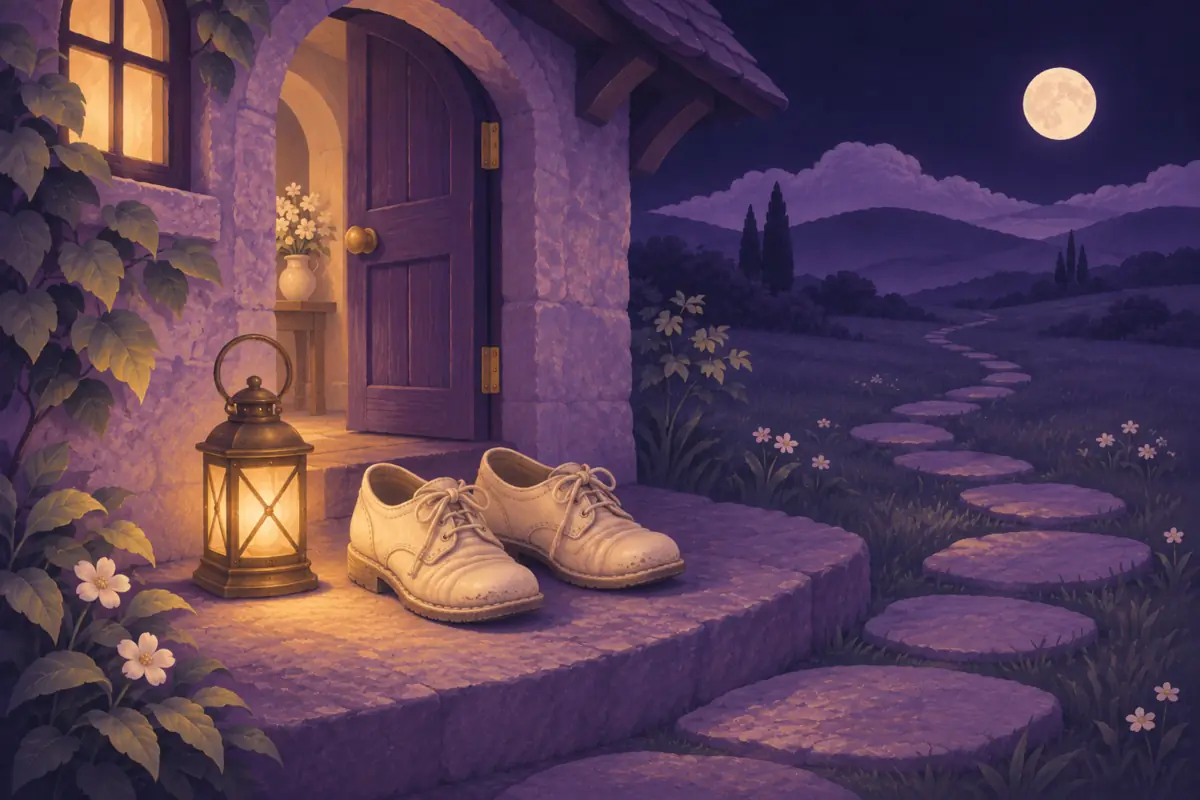
Explore shoe dreams through missing pairs, tight fits, mismatched shoes, unfamiliar footwear, worn soles, and comfortable bare feet.
A dream about shoes may invite questions about readiness to move, practical support, comfort, or whether what you are wearing suits the route. Missing, tight, mismatched, and unfamiliar shoes create different problems. The image does not predict travel or a change of partner, and bare feet need not mean vulnerability if they feel comfortable.
| Scene | Detail that changes the experience | Question to explore |
|---|---|---|
| You cannot find your shoes | Departure depends on preparation | What movement is delayed? |
| The shoes are too tight | Appearance or requirement has a bodily cost | Could I choose something else? |
| The pair does not match | Function and presentation may differ | Did the mismatch actually interfere? |
| The shoes are new | Useful support is unfamiliar | What required adjustment? |
| Soles wear out or break | A dependable resource fails | What route remains possible? |
| You wear someone else's shoes | Help may not fit perfectly | What terms came with borrowing? |
| Bare feet feel good | Less protection may feel freeing in the scene | What made the setting comfortable? |
| You choose shoes for a route | Preparation reflects the expected task | What conditions did I anticipate? |
The search may happen before work, a journey, a celebration, or a simple walk. Identify what departure would make possible. Missing shoes can delay a chosen activity or provide an unwanted excuse not to face something else.
What is missing: both shoes, one shoe, a specific pair, or any acceptable footwear? The distinction changes whether the task concerns basic readiness, completeness, or a particular standard. You may have alternatives but feel unable to use them.
A useful reflection concerns what you believe must be in place before moving. The dream does not prove unpreparedness or predict a missed trip. It can help you distinguish a practical requirement from a preference that has become compulsory inside the scene. If someone waits for you, their response may add a separate question about pressure or available help.
Describe what the discomfort prevents in the dream: walking normally, keeping pace, standing, or enjoying an event. A pair that looks suitable may still make the actual task difficult. Physical ease and social presentation can pull in different directions.
Why do you keep wearing them, if you do? There may be no alternative, an explicit dress rule, another person's expectation, or your own wish to maintain the appearance. Those reasons should not be treated as interchangeable.
A useful reflection concerns the cost of meeting a particular standard. The dream does not establish a medical problem or prove that a role is wrong for you. If a personal metaphor fits, specify what makes it constraining and whether a change was available. The scene may ask about accommodation rather than a complete rejection of the activity or group you wanted to join.
A mismatched pair may be visually striking without causing any practical difficulty. Notice whether the shoes support the same movement, have different heights, or simply look unlike each other. Your concern may be balance, appearance, or another person's reaction.
Did you choose the combination? An intentional mix can feel playful or resourceful, while an unnoticed mismatch may become embarrassing only after someone points it out. The timing helps distinguish your own preference from an audience's standard.
A useful reflection concerns whether difference actually interfered with the route. The dream does not prove inner conflict or a split identity. It can make compatibility a concrete question: do these two available resources work together for what I need to do? If they do, preserve that success rather than assuming visual consistency is the only meaningful form of being properly equipped.
Newness can feel promising, awkward, impressive, or unnecessary. What changes when you put them on: movement, appearance, confidence, attention, or the sense of being ready? A new pair may fit the occasion while still feeling unlike your usual choice.
Notice whether you have selected them, received them, or discovered them without explanation. Ownership of the decision can change the experience. You may welcome the support but feel uncertain about what the shoes seem to say to others.
A useful reflection concerns adjusting to a resource that has not yet become familiar. The dream does not predict a new journey, partner, or social role. It can help you describe the difference between something being useful and something already feeling natural. If the shoes are comfortable immediately, that ease deserves attention without becoming a promise that all new circumstances will fit as well.
The failure may happen gradually or at a decisive moment. Describe what stops working: grip, protection, fastening, or the ability to keep the shoe on. A visible sign of age differs from a practical breakdown that changes the route.
Your response may involve repair, slowing down, finding another pair, asking for help, or continuing with an adjustment. The dream may make replacement easy or leave you without resources. Those conditions matter before any judgment about your effort.
A useful reflection concerns support that once worked but no longer suits the task. The dream does not prove exhaustion or predict a setback. If a waking comparison fits, identify the particular tool, routine, or arrangement rather than calling your whole life worn out. The scene can raise a question about maintenance and adaptation without requiring a dramatic interpretation of failure.
The borrowed pair may solve an immediate problem while creating a different fit. Who offers it, and do you feel comfortable accepting? A willing loan differs from taking an available pair without knowing whether it is yours to use.
Notice whether the owner's identity matters. You may associate the shoes with a job, family member, admired person, or ordinary practical resource. The dream does not automatically ask you to understand that person's entire perspective simply because you wear their footwear.
A useful reflection concerns support that comes through another person's resources. Does accepting help require adjustment, gratitude, permission, or a later return? The dream does not establish that you lack independence. It can make the terms of borrowing visible, including whether an imperfect but available solution lets you proceed or asks you to tolerate a cost that feels too high.
The setting determines much of this experience. Soft ground, a familiar room, warm sand, or an imagined surface can make bare feet feel comfortable. Describe what the absence of shoes allows: ease, quiet movement, contact with the ground, or relief from a constraining pair.
Do other characters share your comfort? Someone may object even when the scene feels safe to you, creating a difference between personal ease and an external rule. That tension can matter more than the bare feet themselves.
A useful reflection concerns which kind of support you wanted. Less equipment can feel freeing in one dream and exposing in another. The image does not automatically mean poverty, vulnerability, or spiritual purity. Keep the actual sensation and setting ahead of a fixed interpretation, and do not turn the dream into practical advice about what is appropriate for a real route.
Preparation can be the whole task: choosing between boots, formal shoes, a familiar pair, or something suited to an uncertain destination. What conditions do you expect? Distance, weather, terrain, appearance, and other people's rules can pull the decision in different directions.
Notice how much you know about the route. You may prepare carefully with clear information or keep changing your choice because the destination shifts. Uncertainty about the task can make even a simple selection feel difficult.
A useful reflection concerns matching resources to actual needs. The dream does not forecast travel or certify readiness. It can help you ask whether you are preparing for the activity itself, an audience's judgment, or a worst-case expectation that may not appear. Those are different goals, and the best-fitting shoe within the scene depends on which goal you are trying to serve.
Shoes appropriate for one scene may be unsuitable for another. A formal event, long walk, unfamiliar surface, and quiet room create different requirements. Before interpreting the pair, describe what you wanted to do while wearing it.
Then separate appearance from function. You may look prepared but struggle to move, or feel comfortable in a pair that attracts unwanted attention. Neither alone establishes whether you belong or are capable.
A useful sentence is, “These shoes helped or prevented me from…” The answer keeps the reflection specific. It also leaves room for a dream that draws on an ordinary search, recent purchase, worn pair, or familiar routine rather than a hidden life transition.
A mismatch can involve the equipment, the task, or the conditions. The dream does not require you to conclude that your body, character, or direction is wrong. Changing the resource may be more relevant than judging the person using it.
Personal sayings about paths or walking in another's shoes may provide associations, but they are not universal dream rules. Explain why a phrase fits the actual scene and what detail might challenge it.
No travel or relationship prediction follows from a new pair, a missing shoe, or a broken sole. The image can still invite a thoughtful question about readiness, support, and the cost of moving in a way that does not feel comfortable.
The image does not predict travel or a particular change. Ask what the new shoes allowed you to do and whether they felt useful or unfamiliar. If a real journey is already on your mind, that can be a personal association without making the dream a forecast about when or how it will happen.
No relationship outcome follows from a missing shoe. The dream may involve incomplete preparation, a practical obstacle, or concern about appearance. Identify what the missing item prevented in the scene. A metaphor about partnership is optional and should not become evidence that a real connection is about to change.
Keep the comfort and describe the setting that made it possible. Bare feet do not automatically mean vulnerability or lack. You may have felt relief from a constraining pair or enjoyed contact with the ground. The dream's conditions matter, and they should not be converted into practical advice for a waking environment.
That may be a personal comparison, but it is not established by the image. Ask what the shoes prevented and why you kept them on. The scene might concern an unavailable alternative, a dress requirement, or a temporary task. A specific question about accommodation is more useful than a broad verdict about your life.
Educational reflection only. Interpretations are not diagnoses, evidence about other people, or predictions.
Atlas has already read this article.
Explore eight police dream scenes through help, authority, questioning, and responsibility, while keeping personal experience ahead of a fixed meaning.

Explore eight shooting dream scenes through uncertainty, responsibility, sound, and the remembered aftermath, without inferring intent or predicting harm.

Explore eight non-graphic killing dream scenes through intention, responsibility, witnessing, and regret, without treating the dream as proof of desire.



Short quizzes about your dreams.
Write down dreams before they fade.
What NightAtlas is and how it works.


