

Dream About Police: Help, Rules, and Being Heard
Explore eight police dream scenes through help, authority, questioning, and responsibility, while keeping personal experience ahead of a fixed meaning.
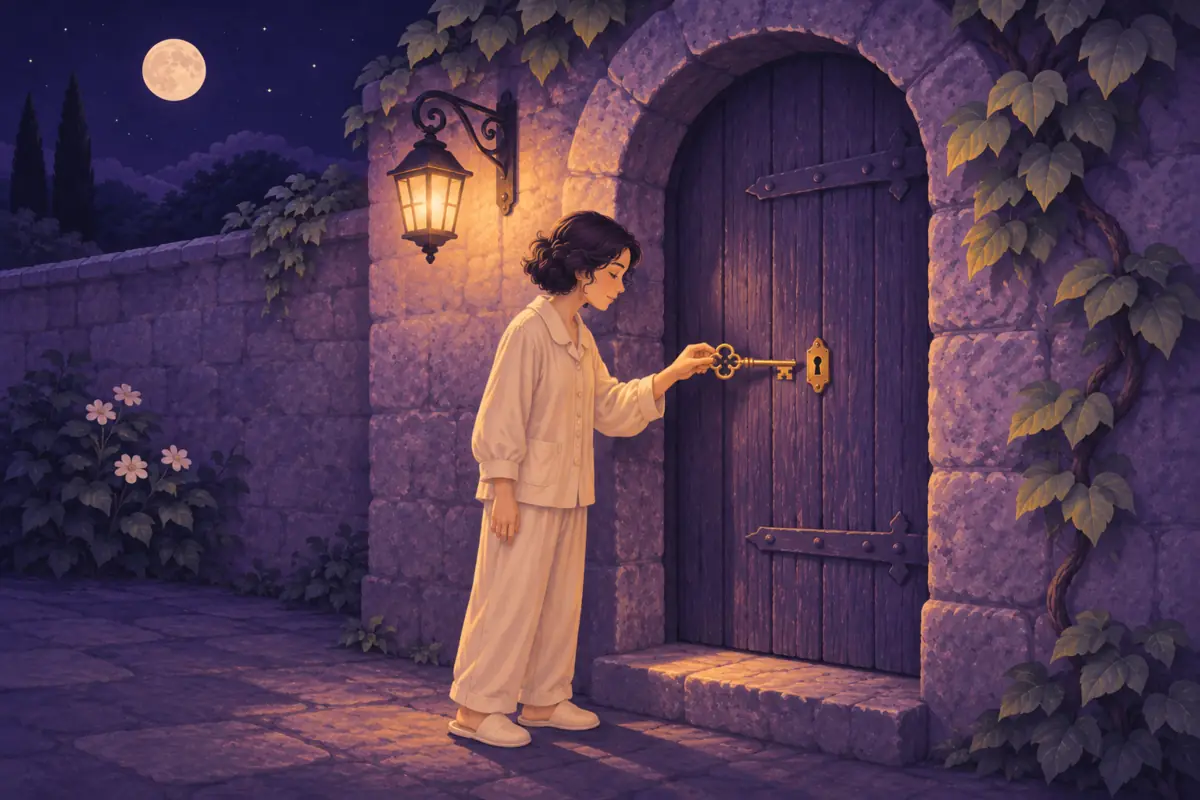
Explore key dreams through working locks, lost keys, broken tools, borrowed access, and choosing whether to open or secure a door.
A dream about a key may invite questions about access, permission, a means of overcoming a specific obstacle, or responsibility for a boundary. What the key opens or secures matters more than the object alone. Finding one does not guarantee a waking solution, and possessing one does not necessarily mean you want to enter.
| Scene | Important distinction | Question to explore |
|---|---|---|
| A key fits | Access becomes possible | What did opening enable? |
| Your key is missing | A familiar route is unavailable | What ability depended on it? |
| You have many keys | Options lack clear matches | What information would narrow the choice? |
| A key belongs to someone else | Ability and permission differ | Was access offered? |
| A key breaks | The tool cannot complete its task | What alternatives remained? |
| Someone gives you a key | Access arrives with expectations | What responsibility came with it? |
| You lock a door | A boundary is deliberately maintained | What did I want protected? |
| You choose not to use a key | Opportunity is available but declined | Why did I prefer the door closed? |
Describe the obstacle before the success. You may have been locked out of home, trying to reach a person, exploring a room, or opening a container. The practical purpose determines what changes when the key works.
What happens after opening? Relief may give way to curiosity, another task, or disappointment about what is inside. A solved access problem does not automatically resolve the entire scene. Sometimes the important event is simply that a familiar tool behaves as expected.
A useful reflection concerns the fit between a means and a particular need. The dream does not promise that a real problem will soon be solved. It can help you name what made the solution usable: the correct tool, permission, timing, or knowledge of the lock. Keep that specificity rather than treating every working key as a universal sign of success.
A missing key may interrupt departure as well as entry. You might be unable to lock a door before leaving, start a journey, retrieve belongings, or return to a private space. Identify the exact ability that becomes unavailable.
The search can involve remembered locations, other people, repeated checking, or uncertainty about whether the key ever existed in the dream. Notice what you know and what you assume. Frustration may come from expecting a familiar object to be easy to locate.
A useful reflection concerns dependence on a small practical resource. The dream does not prove that you are disorganized or about to lose access in waking life. If a metaphor about opportunity fits, explain why. A missing house key may concern privacy or routine much more directly than an abstract chance you fear has passed.
Many keys can feel promising or burdensome when you do not know which one fits. Are they labeled, familiar, nearly identical, or attached to objects too heavy to carry comfortably? The arrangement changes the task from having access to identifying the appropriate means.
You might test them systematically, choose by appearance, ask someone, or become frustrated by the number of possibilities. The dream may make abundance less useful than one clear match. That distinction is worth preserving.
A personal question concerns what information would turn options into usable choices. This does not mean your waking life has too many opportunities. The scene may simply offer an experience of possessing resources without a map of their purpose. If one key finally works, record what identified it rather than rewriting the outcome as proof that persistence always produces a solution.
Possession and permission are separate. The key may be lent, found, taken accidentally, or available without explanation. Describe what you understand about your right to use it inside the dream.
The intended destination matters. Entering to help someone differs from satisfying curiosity or retrieving your own belongings. You may feel trusted, uneasy, entitled, or unsure whether using the key crosses a boundary. Those feelings should not be reduced to a simple judgment about honesty.
A useful reflection concerns the terms of access. What was offered, what was assumed, and what remained private? The dream does not reveal a real person's secrets or instruct you to investigate them. It can make the difference between being able to open a door and being invited through it especially visible, which is a more precise question than declaring that keys always represent power.
The tool may fail before entry, become stuck, or leave part of itself behind. Describe the practical result rather than assuming the broken object represents you. The problem may be a mismatch, an obstacle in the lock, or unexplained dream mechanics.
Your response can involve asking for help, looking for another entrance, abandoning the attempt, or worrying about making the situation worse. These alternatives show that one failed method does not necessarily erase every possible action.
A useful reflection concerns what happens when a trusted means stops working. The dream does not predict a setback or prove personal incapacity. If a waking comparison fits, identify the tool or approach involved rather than making the entire life situation “broken.” The scene may raise a question about replacement, support, or whether the original goal still matters enough to pursue by another route.
A gift of access can carry trust, welcome, responsibility, or an expectation you did not request. Who gives the key, what do they say it opens, and do you want it? A clear invitation differs from an unexplained object placed in your hand.
Notice whether accepting changes your role. You may become a guest, resident, keeper, worker, or person expected to protect something. The key's significance may lie less in freedom than in the duty attached to it.
A useful reflection concerns what you understood yourself to be accepting. The dream does not promise an opportunity or prove someone trusts you in waking life. It can help distinguish being welcomed, being authorized, and being made responsible. Those experiences can overlap, but a thoughtful account should not assume that every offered key feels like an unqualified gift.
Keys close as well as open. What did you want to keep secure: belongings, privacy, a resting person, or a space you were leaving? The purpose changes whether locking feels protective, restrictive, routine, or uneasy.
Where are you after the door is locked? Remaining inside differs from walking away with responsibility for return. You may also worry that someone else needs access or discover that the boundary affects more people than expected.
A useful reflection concerns the kind of separation you intended. The dream does not prove you shut others out emotionally or need to remove a boundary. A closed door can serve a legitimate purpose within the scene. Ask whether the key gives you a choice about contact and timing, and whether that choice is shared, respected, or complicated by another person's needs.
Available access does not make entry compulsory. You may know what lies beyond, remain uncertain, or realize the room is not where you want to go. Describe the reason for pausing or declining without assuming it must be fear.
Your feelings may include relief, regret, curiosity, or satisfaction that the decision is yours. Another character might pressure you to use the key, making the distinction between opportunity and obligation central to the scene.
A useful reflection concerns what makes a possibility worth choosing. The dream does not establish avoidance or tell you to reject a real offer. It can help you describe the freedom to leave a door closed, at least for now. If you keep the key, notice whether future choice matters; if you return it, consider what responsibility or expectation you are declining alongside access.
A key gains meaning through the lock, destination, and purpose attached to it. Home, workplace, storage, a vehicle, and an unknown room each create a different access problem. A general claim that keys mean answers may miss most of the scene.
Write what you wanted to do before using the key and what became possible afterward. If nothing changed, that may be the important detail. The tool might offer the appearance of access without functioning, or work perfectly for a destination you no longer want.
This approach keeps intention and outcome separate. It also leaves room for ordinary associations such as moving, lending a key, changing a routine, or searching for something recently misplaced.
Ask who owns the space, who controls the key, and who decides when it may be used. These roles need not belong to the same person. The dream may make the arrangement clear or leave it uncertain.
A personal metaphor about trust can fit when the scene supports it, but it should not become evidence of another person's intentions. Receiving a key in a dream does not reveal a real invitation, and losing one does not establish rejection.
No promise of discovery follows from the object. You can find the image encouraging, frustrating, or intriguing while keeping its significance at the scale of a particular question about access, security, or choice.
The dream does not guarantee a waking solution. Ask what the key actually opened and whether that resolved the problem in the scene. A useful personal reflection concerns the fit between a means and a need, rather than treating the object's appearance as a promise that an answer is about to arrive.
Start with the ability that became unavailable: entering, leaving securely, traveling, or retrieving something. Those are different problems. The dream does not prove carelessness or predict a lost opportunity. If a personal metaphor fits, it should explain the specific access issue rather than replacing it with a broad claim about your life.
No prediction follows from the break. It may make a failed method, mismatch, or need for another approach vivid within the dream. Notice what alternatives remained and how you responded. The scene cannot establish that a real plan is doomed or that you are unable to handle a waking problem.
Access can be available without being wanted. You may prefer privacy, lack information, recognize another person's boundary, or simply have a different destination. The dream does not automatically label the choice avoidance. Describe what mattered to you and whether keeping the option open felt different from rejecting it entirely.
Educational reflection only. Interpretations are not diagnoses, evidence about other people, or predictions.
Atlas has already read this article.
Explore eight police dream scenes through help, authority, questioning, and responsibility, while keeping personal experience ahead of a fixed meaning.

Explore eight shooting dream scenes through uncertainty, responsibility, sound, and the remembered aftermath, without inferring intent or predicting harm.

Explore eight non-graphic killing dream scenes through intention, responsibility, witnessing, and regret, without treating the dream as proof of desire.



Short quizzes about your dreams.
Write down dreams before they fade.
What NightAtlas is and how it works.


