

Dream About Police: Help, Rules, and Being Heard
Explore eight police dream scenes through help, authority, questioning, and responsibility, while keeping personal experience ahead of a fixed meaning.
Explore dreams of hidden rooms, locked doors, stored belongings, extra space, and unexpected occupants through eight questions of discovery.
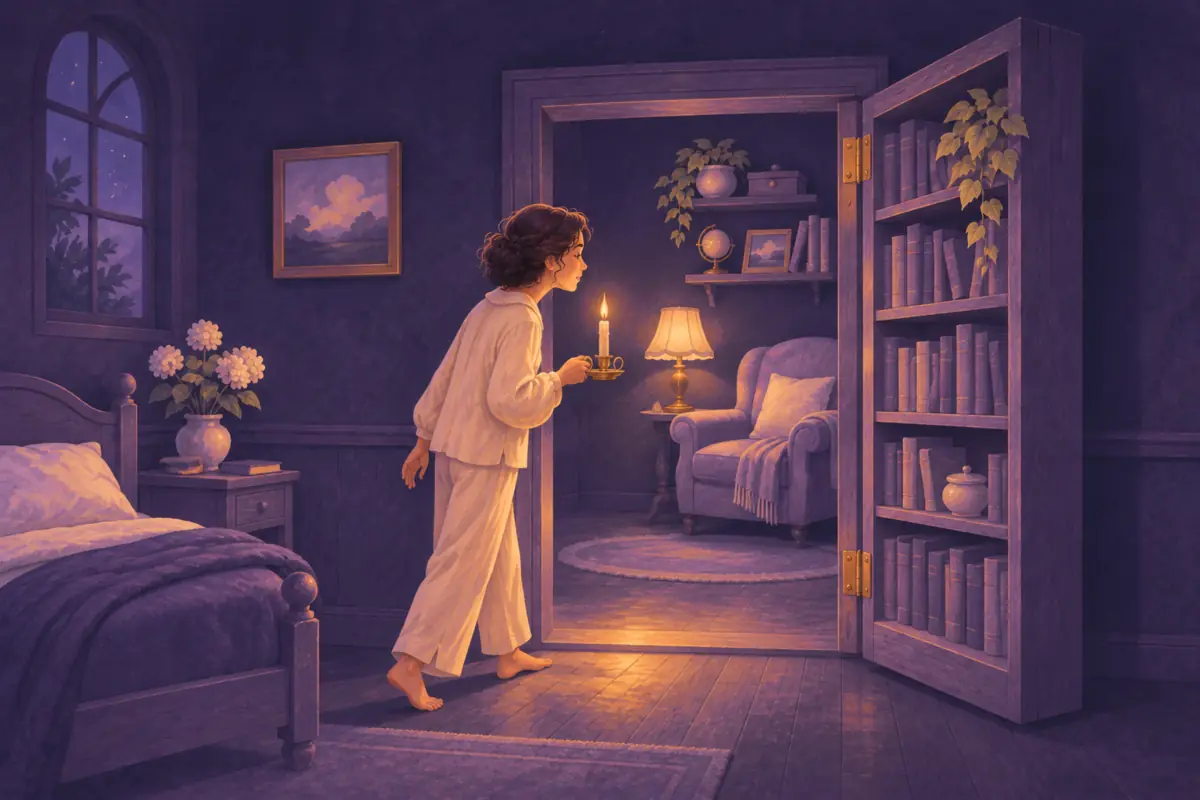
A dream about finding a new room may invite questions about unexpected possibilities, unfamiliar parts of a known place, privacy, or the cost of exploration. The room's condition and your right to enter matter. Its discovery does not prove hidden talent, a repressed memory, or a secret that exists outside the dream.
| Scene | Important distinction | Reflection question |
|---|---|---|
| A bright empty room | Possibility without a defined use | What did I want to do there? |
| A locked room | Discovery does not grant access | Who could open it? |
| A room full of belongings | Space arrives with a history | What seemed mine to handle? |
| A neglected room | Opportunity includes work | Was I willing to take responsibility? |
| A threatening room | Curiosity meets a limit | Could I choose not to enter? |
| Someone already lives there | Discovery crosses another boundary | Was I welcomed or intruding? |
| Rooms continue endlessly | Expansion becomes difficult to map | Did more space remain desirable? |
| The room vanishes | Access cannot be repeated | What did I want to preserve? |
An empty room can feel generous, unfinished, lonely, or full of possibility. Describe the light, dimensions, windows, and how it connects to the rest of the building. A large space with no exit differs from a modest room opening onto a garden.
Your first imagined use may be the most personal detail. You might want to work, rest, invite someone, store belongings, or leave it empty. The dream does not have to reveal a hidden ability; it may simply give shape to a wish for a particular kind of space.
A useful reflection concerns what the room would allow that existing rooms did not. Privacy, quiet, room for company, and freedom from clutter are distinct possibilities. If you felt no need to use it, preserve that too. Discovery can be pleasurable without immediately becoming a project, obligation, or instruction to expand your life.
Knowing a room exists is different from being able to enter. You may see it through glass, find an unfamiliar door, or receive a description from another character. Record how much you actually know about the interior rather than filling it with imagined contents.
Who controls access? A missing key, another person's permission, an unfamiliar mechanism, and a rule against entry create different barriers. You might search, ask, wait, try another route, or decide that knowing the room exists is enough.
A personal comparison with an unavailable possibility can fit, but the dream does not prove you have a psychological block or a secret memory behind the door. Ask what you wanted access for. Curiosity and need are not the same, and a boundary can be frustrating without being illegitimate. The scene may end at the threshold without requiring you to force an interpretation of what lies beyond.
Furniture, boxes, clothes, papers, and photographs can make the new space feel inhabited by a history. Did you recognize the objects, know their owner, or simply assume they belonged to the past? The basis for that impression matters.
Your response may involve sorting, touching, reading, leaving everything alone, or calling someone to identify an item. Discovery can quickly become a question of permission: being able to enter does not necessarily mean everything inside is yours to examine or remove.
A useful reflection concerns how you relate to material whose story you do not fully know. If an object resembles something from your life, name the resemblance without treating the dream as documentary evidence. A convincing feeling of familiarity does not establish a recovered event. The room can invite curiosity about memory while leaving the actual past dependent on information beyond the dream.
Extra space may arrive with dust, leaks, damaged furniture, or unfinished surfaces. Describe the work as it appears in the scene. A small repair differs from a room whose condition makes entry difficult, and your willingness may depend on that scale.
Did you feel excited to restore it, burdened by an unexpected task, or annoyed that nobody mentioned it earlier? These reactions can coexist. A possibility can be attractive while the responsibility attached to it feels unwelcome.
A personal comparison might concern an opportunity that requires resources before it becomes useful. Ask what you believed you would gain and what the work would cost. The dream does not predict a new venture or tell you to accept one. It gives you a setting in which discovery and maintenance appear together, allowing a more realistic question than the assumption that every hidden room represents effortless potential.
Identify the source of unease. A sound, unstable floor, unfamiliar figure, darkness, or an unexplained certainty can each make the threshold difficult. If the fear had no visible cause, record that rather than inventing an object to justify it.
What options did you have? You might close the door, ask someone to accompany you, turn on a light, or enter despite hesitation. A dream does not have to reward entry or punish withdrawal. Curiosity is one intention among others, including preserving comfort and choosing when to investigate.
If the scene prompts a personal question about the cost of exploration, keep it modest. The room does not prove a traumatic memory is waiting to be uncovered. Nor does fear establish that an actual opportunity is unsafe. The useful detail may be whether you felt entitled to pause, gather information, or decide that this was not a space you wanted to enter.
A room you thought was an extension of your home may turn out to be someone else's private space. How did you learn that? A person may greet you, object to your presence, or remain unaware while you look around.
The discovery changes ownership. You might feel embarrassed, relieved, curious, or entitled to an explanation about why the room exists. Notice whether the occupant treats you as a guest, intruder, neighbor, or expected arrival. Those roles create different questions about belonging.
A useful reflection concerns the limits of discovery: finding something does not automatically make it yours. This can fit a particular waking interaction if you recognize it, but the dream cannot reveal a real secret life or hidden resident. Keep the encounter at the level of the remembered relationship, including whether permission to remain was offered and whether you wanted to accept it.
Expansion can change from delight to disorientation. At first, extra rooms may feel abundant; later, you may worry about finding your way back, maintaining the building, or understanding where it ends. Describe when the emotional tone shifts.
The rooms may repeat or differ radically. A series of identical doors creates a different problem from a sequence of distinctive spaces. You might try to map them, choose one to explore, bring someone along, or stop counting.
A personal question concerns the point at which more options become harder to use. That is not a universal lesson against expansion. It depends on your goal and the dream's conditions. If wandering remained enjoyable, preserve the pleasure. The scene does not prove endless hidden potential or endless unresolved problems; it offers an experience of scale that may exceed your need for a single useful room.
Perhaps the door disappears, the corridor changes, or you return with someone and discover only a wall. The loss may concern the space itself or the inability to share and verify what you found. Which mattered more?
Your response can include searching, explaining, doubting your route, or accepting that the encounter was temporary. If another character disbelieves you, the scene gains a question about credibility. If you are alone, the feeling may instead concern preserving something before it fades.
A useful reflection asks what you wanted to keep: privacy, an opportunity, a view, an object, or the experience of discovery. The room's disappearance does not predict that a real chance will vanish. It also does not establish that you have forgotten a literal place. The ending can remain a loss of access within the dream without becoming evidence about hidden architecture or memory.
“New room equals hidden talent” is appealing but too narrow for many scenes. A room may belong to someone else, require repairs, feel unsafe, or offer welcome emptiness without any demand to achieve. Its function and your intention deserve attention.
Try completing the sentence, “This room changed what I could…” You might write rest, hide, host, store, explore, leave, or understand. Then ask whether that change was wanted. This makes the reflection more precise than assuming expansion is automatically positive.
Ownership is equally important. Did you discover the room in your home, a rented building, a workplace, or a place with no clear owner? The right to enter and the obligation to maintain it may differ. Those relationships can carry much of the scene's meaning.
A dream can create a strong feeling that a room has always been there. Preserve that feeling as part of the scene without treating it as evidence of a forgotten event. “I knew this was my old room in the dream” is different from recognizing an actual room afterward.
When recording the account, distinguish remembered details from later explanations. If you infer that boxes belonged to a relative, label the inference. Do not turn a plausible story into a recovered fact merely because it makes the room feel coherent.
Personal, spiritual, or cultural associations can be explored with their context named. None is needed to establish that discovery felt meaningful. The room can prompt a question about possibility or boundaries without claiming a supernatural source, a hidden diagnosis, or a memory that must be uncovered.
That is one possible personal metaphor, not a conclusion established by the image. Ask what you wanted to do in the room and whether it supported that activity. A locked, occupied, or unwanted room may raise different questions. The dream does not certify an ability merely by showing additional space.
The dream alone cannot verify a forgotten event. A feeling of familiarity, old belongings, or a childhood setting remains part of the dream account rather than proof of history. Keep actual recollections and independently known facts separate from the story you construct to explain an unfamiliar room after waking.
Describe what made it frightening and whether you could choose to pause or leave. Fear does not establish that a hidden truth must be confronted. The scene may involve uncertainty, boundaries, or an unfamiliar setting. You can explore those questions without assuming that entering the room was the only meaningful response.
You may have lost access to something you wanted: quiet, possibility, a view, or the chance to share a discovery. Name that specific loss before assigning a broad meaning. The disappearance does not forecast a missed opportunity; it marks an ending within the dream that may still carry personal emotion.
Educational reflection only. Interpretations are not diagnoses, evidence about other people, or predictions.
Atlas has already read this article.
Explore eight police dream scenes through help, authority, questioning, and responsibility, while keeping personal experience ahead of a fixed meaning.

Explore eight shooting dream scenes through uncertainty, responsibility, sound, and the remembered aftermath, without inferring intent or predicting harm.

Explore eight non-graphic killing dream scenes through intention, responsibility, witnessing, and regret, without treating the dream as proof of desire.



Short quizzes about your dreams.
Write down dreams before they fade.
What NightAtlas is and how it works.


