

Dream About Police: Help, Rules, and Being Heard
Explore eight police dream scenes through help, authority, questioning, and responsibility, while keeping personal experience ahead of a fixed meaning.
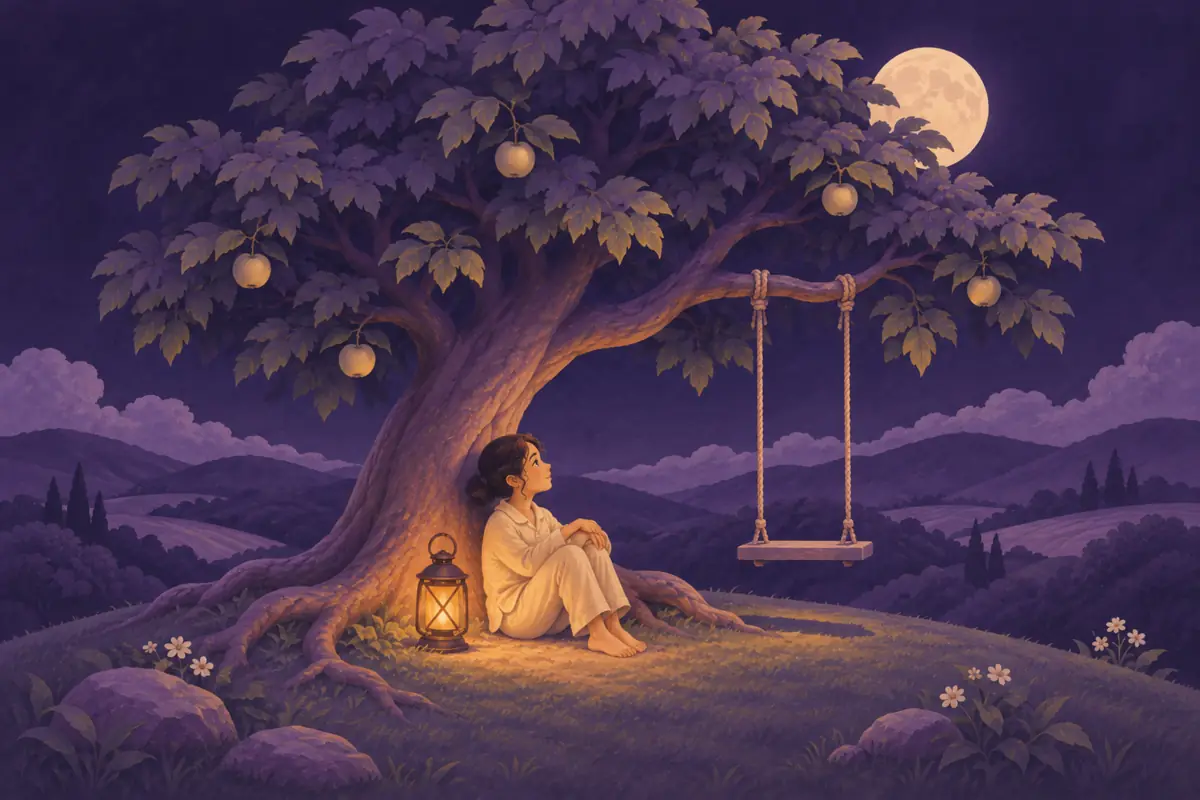
Explore tree dreams through exposed roots, broken branches, fruit, climbing, and familiar shade, with questions about what the tree provided.
A dream about a tree may involve stability, growth, shelter, branching possibilities, or a personal connection with a place. The tree's role matters more than its presence alone. Climbing it, eating its fruit, or noticing its absence creates different questions. It does not provide a reliable picture of your family, health, or future.
| Scene | Detail to preserve | Question to consider |
|---|---|---|
| Roots are exposed | Support, obstruction, or discovery | What held the tree in place? |
| A branch breaks | Lost support or changed access | What depended on that branch? |
| Fruit is ready to pick | Reach, permission, and company | What made the result available? |
| A tree has been cut down | A known change or unexplained absence | What function was lost? |
| You climb a tree | A view, play, refuge, or a task | Why did I want to go higher? |
| You rest in its shade | Comfort, waiting, or concealment | What made the pause welcome? |
| You plant a tree | Chosen care or an assigned duty | What would ongoing attention require? |
| A familiar tree changes | Recognition and surprise | Which memory made the change matter? |
Exposed roots can draw attention to something usually partly hidden, but they may also be ordinary features of the landscape. Were you examining them, stepping over them, or worried that the tree had become unstable? The action clarifies their significance.
Notice whether the roots connected the tree firmly to the place or interfered with a path. The same feature can support one thing while complicating another. You might admire their shape, find something between them, or use them as a place to sit.
For reflection, ask what arrangement provided support and what that support required. A family association may fit a particular memory, but roots do not automatically represent ancestry. Keep the concrete scene first. If you connect the roots with a relationship or routine, explain the resemblance rather than assuming anything underground must reveal a hidden origin.
The branch's role changes the meaning of its loss. Were you standing on it, watching from below, collecting fruit, or noticing damage afterward? A break that interrupts an activity differs from one that creates space or removes something already in the way.
Describe the cause only if you remember it. Wind, weight, another person's action, and an unexplained snap create different stories. It is easy to fill the gap with a theory about weakness, but the dream may not provide evidence for one.
A personal comparison could concern reliance on something that changes unexpectedly. Ask what you did next: sought another support, helped someone, left, or continued without difficulty. The scene cannot establish that a relationship is about to fail. It can help you identify what made a particular support important and how its loss affected the immediate task.
Fruit can turn a tree into a source of something you want, but the details matter. Was the fruit familiar, reachable, ripe within the dream, or reserved for someone else? You might enjoy choosing it, struggle to reach it, or wonder whether you were allowed to take it.
Who else was present? Sharing, collecting for another person, and competing for the last piece create different social scenes. The activity may center on generosity, access, appetite, or the satisfaction of an ordinary task rather than a grand symbol of success.
For reflection, ask what made the result available and what you intended to do with it. A comparison with the outcome of effort may fit, but the dream does not promise wealth or achievement. It may simply recall a garden, a taste, or a moment of company that matters personally.
An absent tree may be noticeable because it used to provide shade, a landmark, a boundary, or a place associated with someone. Identify the lost function before interpreting the stump. Grief about a familiar place differs from relief that a blocked view has opened.
Did you know who removed it and why? The dream may show an action, supply an explanation, or leave you only with the result. Preserve uncertainty rather than assigning blame to a character who happened to be nearby.
An editorial comparison could concern a change decided without your involvement. The useful question is what consultation, acknowledgment, or practical adjustment you wanted. The tree does not automatically stand for a deceased relative or a severed family bond. A specific real tree can matter as a living part of a place without needing to represent a person at all.
Climbing can serve many purposes: reaching an object, playing, finding a view, hiding, or joining someone already above. Start with that purpose. Going higher is not inherently ambition, and staying in a branch is not necessarily escape from responsibility.
Notice how the tree accommodates you. Branches may feel easy to reach, too far apart, sturdy, or uncertain. You might climb confidently but hesitate about coming down. The relation between ascent and return can be more important than the final height.
For reflection, ask what changed when you left the ground. Did you gain perspective, privacy, access, or distance? Each answer supports a different personal comparison. The dream cannot assess your courage or competence. A useful reading keeps the activity's goal and available supports together instead of turning every upward movement into a statement about personal growth.
Shade or shelter can make a tree part of an ordinary pause. Were you resting, waiting for someone, reading, or avoiding a crowd? The reason for staying gives the scene a focus beyond the tree's appearance.
Describe the atmosphere. A broad canopy may feel comfortable, a low branch intimate, or falling leaves distracting. You may have been content alone or felt that a particular person was missing. Quiet can support different emotional experiences without changing the physical setting.
A personal question concerns what makes rest possible. Was it a place to sit, a familiar landmark, time without interruption, or company? The dream does not establish that you are depleted or need to withdraw. It may simply help you recognize a kind of comfort you enjoy. An uneventful scene can be meaningful without concealing a problem that must be solved.
Planting gives the dream an activity with a future beyond the immediate scene. Notice where you put the tree and whether the place felt suitable. A garden, a pot, a roadside, and an unexpected indoor location imply different kinds of access and attention.
Was the task chosen? You might be excited to begin, uncertain about responsibility, or helping someone fulfill their plan. The young tree's needs in the dream may be realistic or fantastical; describe them without treating the scene as practical horticultural advice.
For reflection, distinguish beginning something from maintaining it. What resources did you imagine would be needed later, and who would provide them? A comparison with a project or relationship may fit your circumstances, but it is not automatic. The dream does not promise that a new commitment will flourish or judge whether you are prepared to care for it.
Recognition and change can coexist. The tree may be larger, leafless, flowering out of season, or in the wrong place while still feeling unmistakably familiar. Write down which detail made you recognize it and which detail surprised you.
Your response might be delight, confusion, sadness, or an urge to show someone. The emotional meaning may depend on the tree's connection with an earlier period of life rather than on the change itself. A new appearance does not have the same significance for every dreamer.
A personal question concerns how you relate to something that remains familiar while changing. You might compare that experience with a place or relationship, but the dream cannot establish anyone's health or future. Keep recognition, memory, and observation separate. A dream tree losing leaves is not evidence that a person connected with it is declining.
Before calling a tree your family, your body, or your future, describe what it did in the scene. It may have provided a route, blocked a view, held an object, or simply marked a place. Those functions can lead to useful questions without requiring the tree to stand for an entire life.
Your actions are equally important. Caring for a tree, cutting a branch, and noticing a fallen trunk involve different degrees of intention and control. An outcome alone does not reveal the motive. A cut can be part of care within one story and an unwanted loss in another.
Emotion can challenge the expected interpretation. A leafless tree may look beautiful to you; abundant fruit may feel like a task you did not choose. Preserve the feeling rather than replacing it with a standard positive or negative code. The tree's condition is part of the setting, not a reliable assessment of your own condition.
A particular tree can connect with a house, school, trip, person, or repeated routine. Naming that association gives you something concrete to compare with the dream. If there is no recognizable tree, you can still describe the qualities you noticed without inventing a forgotten memory.
The idea of a family tree may be a familiar linguistic association, but it does not make every branch a relative or every broken limb a prediction. Likewise, growth in a landscape does not certify psychological growth. These metaphors are useful only when you can explain their fit and recognize where they stop fitting.
For background on relating dreams to personal context, see Domhoff's continuity chapter. The questions in this guide are editorial tools for comparing details, not a scientific code for reading trees. This guide does not speak for any specific cultural tradition.
It can remind you of family if a personal memory or association supports that connection. The image alone does not establish it. Ask whether the dream included actual relatives, a shared place, or a specific relationship. Avoid assigning people to branches without evidence from your own experience.
The dream does not predict illness or loss. A tree's appearance may feel sad, peaceful, striking, or ordinary depending on the setting and your associations. Describe what changed because of its condition. A leafless tree that still provides a familiar landmark creates a different scene from one that falls across a route.
Fruit does not guarantee a future reward. It may invite a personal comparison with results, nourishment, access, or sharing if those themes fit the scene. Notice whether you could reach it and what you wanted to do with it. The activity gives more detail than a promise of abundance.
Start with your reason inside the dream: making space, completing a task, following an instruction, or acting without a clear motive. Then describe the result and your reaction. The action does not establish hostility toward family or nature. An imagined task is not a reliable moral diagnosis of the dreamer.
Educational reflection only. Interpretations are not diagnoses, evidence about other people, or predictions.
Atlas has already read this article.
Explore eight police dream scenes through help, authority, questioning, and responsibility, while keeping personal experience ahead of a fixed meaning.

Explore eight shooting dream scenes through uncertainty, responsibility, sound, and the remembered aftermath, without inferring intent or predicting harm.

Explore eight non-graphic killing dream scenes through intention, responsibility, witnessing, and regret, without treating the dream as proof of desire.



Short quizzes about your dreams.
Write down dreams before they fade.
What NightAtlas is and how it works.


