

Dream About Police: Help, Rules, and Being Heard
Explore eight police dream scenes through help, authority, questioning, and responsibility, while keeping personal experience ahead of a fixed meaning.
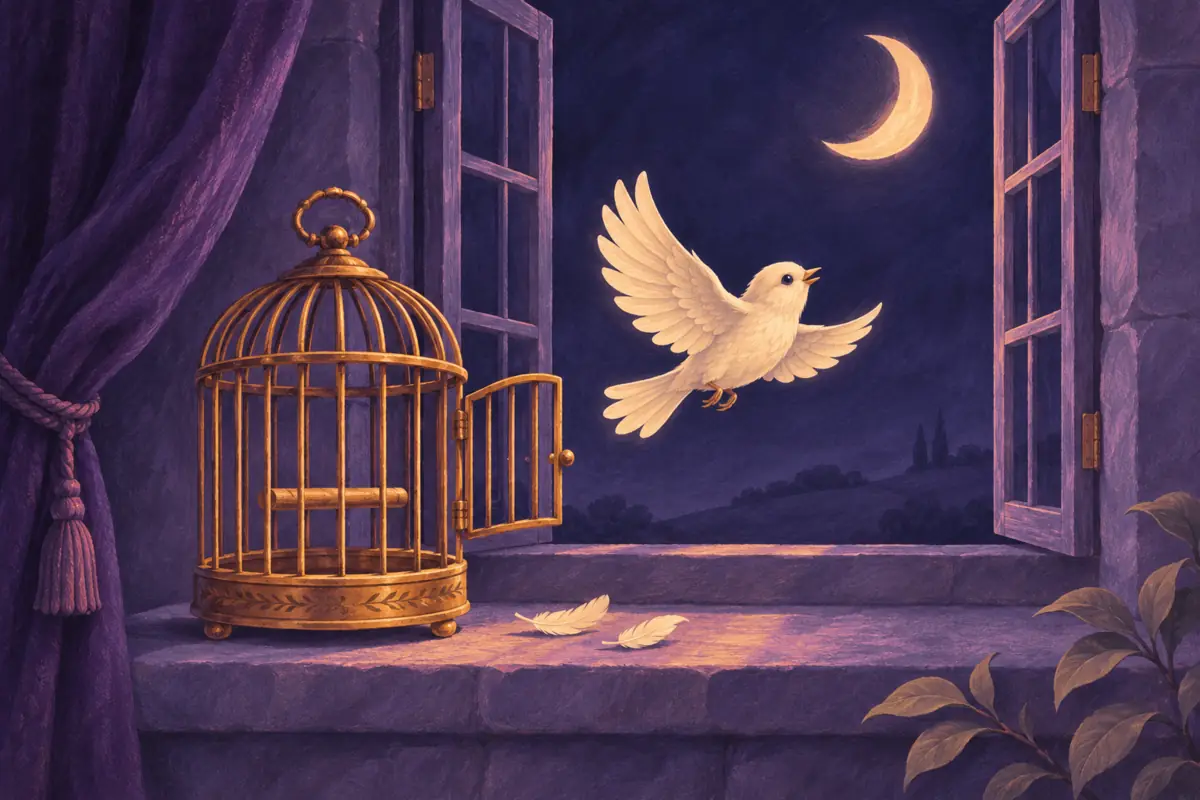
Explore bird dreams through flight, cages, windows, rescue, and gentle contact, with eight scenes and questions about space, care, and freedom.
A dream about birds may invite reflection on movement, distance, delicate contact, or the wish to give something room. A bird flying overhead differs from one trapped indoors or resting on your hand. Notice its behavior, your emotional response, and whether you wanted to approach, protect, hold, or release it.
The kind of bird may be important, but uncertainty is allowed. If you remember only a small shape or a bright color, do not force an identification. A familiar pet, a city bird, and an invented creature bring different associations. The scene's relationships can remain clear even when the species does not.
| Scene | Detail that matters | Question it suggests |
|---|---|---|
| Free flight overhead | Admiration, longing, or relief | Did I want to follow or simply watch? |
| A bird in a cage | Shelter or restriction | Whose needs did the enclosure serve? |
| A bird enters a room | Arrival or failed attempt to leave | What changed about the space? |
| An injured bird | Available help and limits | What kind of care felt possible? |
| A bird lands on your hand | Voluntary contact or restraint | Could closeness remain light? |
| A flock fills the sky | Pattern or confusion | What did the number change? |
| A bird approaches a window | Contact blocked by a surface | What did each side seem to want? |
| You release a bird | Readiness, reluctance, or uncertainty | What did letting go accomplish? |
Look at your position as well as the flight. Were you on a roof, in a field, inside a building, or moving along a road? The bird's freedom may feel different when you are physically restricted than when you are already enjoying an open landscape.
Your desire matters. You might want to fly alongside it, follow its route on foot, photograph it, or simply keep watching. Not every beautiful flight expresses dissatisfaction with life on the ground. Sometimes the scene centers on appreciation without a wish to possess or imitate what you see.
If “freedom” fits, define it concretely. Was the appealing feature height, quiet, speed, room to turn, or the absence of a destination? Those details can make a personal comparison useful. The bird does not announce that a difficult period is ending. It gives you an image through which to ask what kind of movement feels desirable now.
A cage can feel protective, restrictive, familiar, or neglected. Begin with its condition and the bird's behavior. An animal resting comfortably differs from one repeatedly trying to leave. Your impression of the enclosure may also differ from what other characters think it provides.
What was your responsibility? You may own the cage, discover it somewhere, or be unable to reach its door. Opening it could feel kind, risky, or forbidden. These distinctions make care and authority part of the scene rather than assuming the cage simply stands for your life.
A possible reflection concerns the difference between safety and freedom. Ask who benefited from the arrangement and who could change it. If you felt trapped while watching, that association belongs in your notes, but the dream does not prove you must leave a relationship or job. Real decisions require more than the appeal of an open cage door.
The room's layout may drive the whole story. A bird can enter easily and then struggle to find its way out. Record windows, lights, doors, and the people present. Your task may have been to create a route rather than capture the animal.
The arrival may also feel welcome. Perhaps the bird brought interest to a dull gathering or behaved like an expected visitor. If nobody was distressed, do not turn the scene into a problem because an indoor bird seems unusual while awake. Your remembered response is the more useful guide.
If you wanted it outside, notice how you approached the task. Chasing, waiting, opening a window, and asking others to stay still distribute action differently. A personal question might concern making room for an unexpected event without controlling every movement. The bird's entrance does not establish that news, a visitor, or a supernatural message will arrive.
The inability to fly can make vulnerability visible, but the details matter. Was the bird unable to move at all, trying to use one wing, or simply resting while you worried? Distinguish what you observed from what you concluded about its condition inside the dream.
You may have felt uncertain about how to help. Looking for someone knowledgeable, making a quiet space, and preventing another animal from approaching are different forms of care. The dream does not require you to know the correct response or turn uncertainty into a moral failure.
If a personal analogy fits, ask what kind of support was needed: repair, protection, patience, or the ability to leave the scene undisturbed. Avoid assuming the bird represents your own damaged potential. It can remain another creature toward which you felt concern. A dream about injury also does not provide information about anyone's physical health or future prospects.
Voluntary contact changes the encounter. The bird may approach because you held still, offered something, or simply happened to be there. Notice whether you felt chosen, surprised, responsible, or afraid to move. The sensation of a small weight can be more memorable than any symbolic association.
What happened when you adjusted your position? If the bird stayed, contact may have felt adaptable. If you believed any movement would make it leave, closeness could become a delicate performance. Both can be pleasant, but they ask different things of you.
A useful reflection concerns contact that cannot be forced. Did you enjoy the moment without needing it to last, or worry about how to preserve it? This can fit a particular relationship or fleeting experience if you recognize the parallel. It does not mean the bird has selected you for a special role or delivered a message from beyond the dream.
Numbers can create pattern, abundance, noise, or confusion. Describe what the flock did together: crossed your view, circled, scattered, or gathered in a place you needed to pass. The effect on your movement and attention matters more than the simple fact that many birds appeared.
You may remember the group as beautiful from a distance but overwhelming when it came close. That change in scale can be the scene's central event. Alternatively, a scattered flock becoming coordinated may have felt calming, giving shape to a busy sky.
If a comparison with a crowd or many thoughts occurs to you, test it against the remembered action. Were you actually overwhelmed, or did you enjoy the spectacle? A useful interpretation should distinguish those versions. There is no need to turn a large flock into a forecast of abundance or upheaval. The dream's pattern can be interesting without predicting another one.
The window creates a visible connection with a physical separation. Did the bird seem to want entry, fail to notice the surface, or merely rest nearby? These are different stories. If you only remember a sound and then the bird, preserve uncertainty about exactly what happened.
Your position matters too. You may have watched from inside, tried to open the window, or looked for the animal outside. The emotional center might be concern after an impact, frustration at a barrier, or curiosity about an unexpected visitor.
Some people bring ominous associations to birds at windows. A bird at a dream window is not evidence that death or bad news is approaching. If such an association shaped your fear, name it as something you had heard. Then return to the actual encounter: what changed, what you wanted, and what actions were possible within the scene.
Release may be deliberate or accidental. Opening your hands differs from forgetting a cage door, and both differ from deciding that the bird is ready to leave. Record who initiated the departure and whether it matched your intention.
The ending may contain mixed feelings. You can be glad the bird moves freely and sad that contact ends. If it returns, ask whether the return felt like reassurance, unfinished responsibility, or another chance to watch. Avoid turning either departure or return into proof about a real relationship.
A personal question concerns whether care required continued possession. That can be a useful theme without becoming a universal instruction to let go. If the bird did not fly away after release, the dream may instead ask what happens when an offered freedom is not immediately used. Preserve that complication rather than rewriting the ending into an uplifting lesson.
You can want a bird nearby while wanting it free to leave. You can enjoy its flight without wanting to follow. Separating closeness from control makes room for these combinations.
NightAtlas's agency framework asks what you intended, what you could attempt, and what happened. In a bird dream, doing less may sometimes be an intentional way to avoid frightening the animal. In another scene, stillness may feel imposed. The physical posture alone cannot reveal which is true.
Try writing the encounter using verbs: watched, opened, held, waited, followed, released. Then add what each action was meant to accomplish. This often produces a more useful personal account than attaching a broad label such as “freedom” to every wing or sky.
A dream can feel personally significant without establishing a sender. You may associate a bird with someone you miss, a family story, a place, or an earlier experience. Name that connection directly: “This bird reminded me of someone” leaves room for meaning without claiming proof of communication.
This guide does not document a single cultural or spiritual rule for bird dreams. This guide therefore does not assign one. If you wish to explore a tradition that matters to you, its specific texts and context are needed; a generic statement about what all birds symbolize would erase important differences.
Personal symbolism also benefits from detail. The color of a familiar pet may matter because you knew that animal, while the same color in an unidentified bird may simply be a striking visual feature. You do not have to decode every feather.
The dream may feel meaningful, but the bird does not establish an external sender or a prediction. Write down the association it brought to mind, including a person or memory if relevant. You can value that connection while distinguishing a personal experience of significance from evidence of communication beyond the dream.
Not always. Ask whether the cage felt restrictive, protective, familiar, or neglected, and how the bird behaved. Your role also matters: owner, visitor, rescuer, or observer. A metaphor about restriction is useful only when it explains the scene's details rather than replacing them with a standard interpretation.
You can still describe size, movement, sound, color, setting, and your reaction. Do not choose a species merely to obtain a dictionary meaning. “An unfamiliar small bird” is an accurate memory. Uncertainty about its identity does not prevent you from exploring whether the encounter concerned contact, care, distance, or movement.
It does not predict an outcome. The scene may invite questions about limits, support, or interrupted movement, but the bird need not represent your plans. Record what happened and how you responded. If a real project comes to mind, assess its needs using actual circumstances rather than the dream injury.
Educational reflection only. Interpretations are not diagnoses, evidence about other people, or predictions.
Atlas has already read this article.
Explore eight police dream scenes through help, authority, questioning, and responsibility, while keeping personal experience ahead of a fixed meaning.

Explore eight shooting dream scenes through uncertainty, responsibility, sound, and the remembered aftermath, without inferring intent or predicting harm.

Explore eight non-graphic killing dream scenes through intention, responsibility, witnessing, and regret, without treating the dream as proof of desire.



Short quizzes about your dreams.
Write down dreams before they fade.
What NightAtlas is and how it works.


